

🕐 Read Time: 16 min
Cardiology EHR Implementation Guide for Clinics in 2026
Switching to a new EHR system or going through implementation for the first time is one of the most significant operational decisions a cardiology practice can make. The process involves migrating years of patient records, configuring specialty-specific workflows, connecting diagnostic devices, retraining every person on your team, and keeping the clinic running throughout all of it.
Many practice owners put this decision off for months. The project feels too large, too risky, and too disruptive to start. That hesitation is understandable, but it is costly. Outdated or mismatched EHR systems lead to slower documentation, higher claim denial rates, manual data re-entry from diagnostic equipment, compliance risk, and staff frustration that quietly drives turnover.
This guide is written for cardiology clinic owners, practice administrators, and decision-makers who want a clear picture of what EHR implementation actually involves. Not a sales pitch. A clear, honest breakdown of the process, the timeline, the cost, and what separates a smooth implementation from a painful one.
What Cardiology EHR Implementation Actually Means
EHR implementation is not software installation. For a cardiology practice, it is a structured transition project that includes scoping your current workflows, configuring a new system around how your clinic operates, migrating historical patient data, building integrations with your diagnostic devices, training every role on your team, and sustaining the clinic through a go-live period that requires extra attention.
A general-purpose EHR rarely fits cardiology well without significant customization. Cardiology workflows are built around ECG readings, stress test results, echocardiograms, nuclear imaging reports, and device data from pacemakers and cardiac monitors. A proper cardiology EHR implementation sets the system up to handle all of this natively, not as workarounds patched onto a general platform.
The implementation is also not complete when the system technically goes live. It is complete when your team is working at full efficiency, documentation is clean, device data is flowing into charts automatically, and billing is running without friction. Reaching that point typically takes 30 to 60 days after the initial launch date.
Understanding this scope before you begin helps you allocate the right internal resources, set realistic expectations for your team, and choose a vendor that can actually deliver this for a specialty cardiology practice.
If you are still evaluating which direction to go, this overview of EHR for cardiology explains what cardiology-specific platforms do differently from general EHR systems and why that gap matters in daily practice.
Quick Summary: Cardiology EHR Implementation
- Typical timeline: 8 to 16 weeks
- Average cost: $5,000 to $18,000 for small clinics
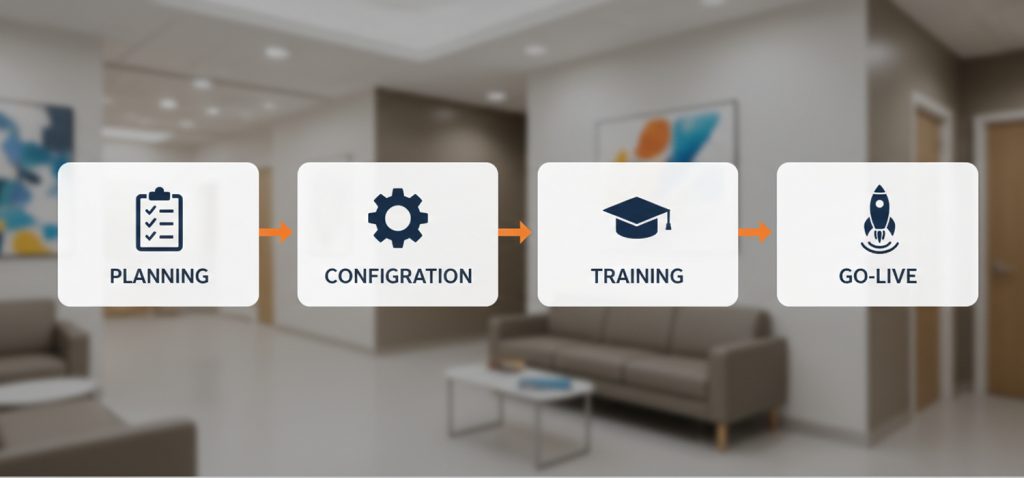
- Key steps: planning, migration, configuration, training, go-live
- Biggest risks: poor data migration, weak training, missing integrations
- Best approach: choose a cardiology-specific system with built-in workflows
Typical Cardiology EHR Implementation Timeline
Most cardiology practices complete implementation in 8 to 16 weeks from contract signing to go-live and it depends on clinic size, data volume and integration complexity.
Here is a realistic phase-by-phase breakdown:
| Phase | Typical Duration |
|---|---|
| Discovery and scoping | 1 to 2 weeks |
| Data migration planning and test migration | 2 to 4 weeks |
| System configuration and customization | 2 to 3 weeks |
| Device and system integrations | 2 to 3 weeks |
| Staff training | 2 to 3 weeks |
| Go-live and immediate post-live support | 1 to 2 weeks |
| Full stabilization | 3 to 6 weeks post-live |
Solo cardiologists or very small practices with limited historical data and straightforward integrations can complete the core process in 6 to 8 weeks. Multi-provider clinics, practices with large patient databases, or those with complex imaging and device ecosystems should budget for 12 to 16 weeks minimum.
Key takeaway: plan for at least 10 to 12 weeks from signing to go-live, and another 30 to 45 days for full stabilization. Rushing any phase creates problems that surface months later, usually in billing or documentation accuracy.
Book a demo to get a personalized timeline and setup plan.
Step-by-Step Implementation Process
Step 1: Discovery and Scoping
Before any software is configured, the implementation team needs a complete picture of how your clinic operates. This includes documenting your current workflows, provider count, patient volume, existing systems, data sources, and diagnostic device inventory.
A thorough discovery process should include separate conversations with your physicians, your clinical support staff, and your billing and front-desk teams. Each group uses the EHR differently and has different requirements. The configuration that comes out of discovery should reflect how your clinic actually works, not a generic cardiology workflow template.
This is also the phase where you and your vendor agree on implementation scope, milestones, and timeline. Anything not documented here becomes a source of confusion or a change order later.
Practices that skip or rush this step spend weeks in post-live reconfiguration. Get it right at the start.
Step 2: Data Migration
Moving your patient data from your current system or paper records into the new EHR is almost always the most complex and time-consuming part of the project. A clean migration requires planning, test runs, and validation before anything goes live.
A vendor you can trust will run at least one full test migration before the live cutover. They will provide a report showing what transferred successfully, what required manual correction, and what could not be migrated automatically. They will also document exactly what the migrated patient record looks like in the new system.
Do not accept a vendor that positions data migration as your internal problem to manage.
Common issues that surface during cardiology EHR data migration include:
- Inconsistent date and time formats across old records
- Missing structured fields for cardiology-specific clinical data
- Duplicate patient records requiring manual review and merging
- Old imaging file formats that need conversion before import
- Proprietary data structures from legacy systems that require custom extraction logic
- Gaps in historical problem lists or medication histories
The quality of your migrated data determines the quality of your patient records going forward. Before migration begins, take time to clean your existing data. Deduplicate records, complete missing fields where possible, and resolve obvious errors. This is your work to do, not the vendor’s, and it pays dividends in the accuracy of every patient chart after go-live.
Data migration is the most complex phase of cardiology EHR implementation and often determines the success of the entire project.
Step 3: System Configuration
This is where the EHR is built around your specific cardiology practice. Configuration includes setting up note templates for your most common visit types, order sets, cardiology-specific documentation forms, referral workflows, scheduling rules, patient portal access, and billing and revenue cycle management processes.
Cardiology-specific configuration also includes connecting ECG systems, echocardiography, nuclear imaging, and Holter monitor data directly into the patient chart. Clinical decision support rules relevant to cardiology, risk scoring tools, and medication management protocols can also be set up during this phase.
The more cardiology-focused your vendor is, the more of this arrives pre-built and ready to adapt. A vendor who has implemented for dozens of cardiology practices brings templates, configuration libraries, and institutional knowledge that a general EHR vendor simply does not have. That translates directly to shorter configuration time and fewer post-live corrections.
Edvak is built specifically for cardiology and includes pre-configured templates, cardiology-specific order sets, and integrated imaging workflows that reduce configuration time significantly compared to general EHR implementations.
Step 4: Device and System Integrations
Cardiology clinics operate more connected diagnostic equipment than almost any other specialty. Before go-live, each device needs a tested, working integration with the EHR. This is not optional. An echo system that sends data to a separate silo, not into the patient chart, creates manual re-entry workflows that your team will live with every day.
Integrations that need to be built and tested for most cardiology practices include ECG and Holter systems, echocardiography platforms, nuclear imaging, cardiac catheterization lab systems, remote patient monitoring devices, lab connections, and hospital interfaces for shared patients.
Each integration takes time to build, test, and validate. Get a confirmed list of supported integrations from your vendor before signing. Ask specifically which are bidirectional, which carry additional fees, and how long each typically takes to complete.
Step 5: Staff Training
Training is where most EHR implementations slow down, and where many ultimately fail. The system can be configured perfectly, and the data migration can be clean, but if the team is not genuinely comfortable using it by go-live, productivity drops sharply and adoption suffers.
Planned training hours by role:
- Physicians: 6 to 10 hours of hands-on, role-specific training
- Nurses and clinical support staff: 4 to 6 hours
- Front desk and scheduling: 3 to 4 hours
- Billing staff: 4 to 6 hours
Training should happen in small groups, use real patient scenarios drawn from your own practice, and include practice time in a sandbox environment before anyone is using the system on actual patients. Video-based training alone is not enough for a system your team will use on every encounter.
Physicians benefit most from focused training on note completion, order entry, and the documentation workflows specific to cardiology visit types. If documentation takes longer after go-live than it did before, physician satisfaction drops quickly. Systems like Edvak include integrated speech-to-text and conversation capture to structured notes that reduce that adjustment period by keeping documentation fast even while the team is still learning the system.
Step 6: Go-Live and Post-Live Support
Go-live day is not the finish line. It is the beginning of the stabilization period.
The first two to four weeks after launch are when staff encounter real-world questions that training did not cover. You need vendor support available during clinic hours, not just a ticket system with a 24-hour response window. A dedicated implementation contact who knows your specific configuration makes a measurable difference in how quickly issues are resolved.
Edvak assigns a dedicated support contact through the first 30 days post-launch. Your team has a direct line to someone who knows exactly how your system was built, not a general helpdesk starting from scratch on every call.
EHR Implementation Cost
Implementation costs vary based on system type, clinic size, and project complexity. Here is a clear breakdown of what to expect.
Cloud-based EHR (the standard choice for independent cardiology practices)
- Monthly subscription: $300 to $700 per provider
- One-time implementation fee: $2,500 to $10,000
- Data migration: $500 to $4,000 depending on volume and source format
- Training: Often included, sometimes billed separately at $150 to $300 per hour
- Device interface fees: $500 to $2,000 per integration with some vendors
For most cardiology practices with one to five providers, total cloud-based implementation costs land between $5,000 and $18,000, inclusive of setup, migration, and training.
On-premise or enterprise deployment
- Upfront software license: $20,000 to $80,000 or more
- Server hardware and infrastructure: $8,000 to $25,000
- Implementation and professional services: $15,000 to $50,000
- Ongoing IT support and maintenance: significant annual cost
- Upgrade fees: typically 18 to 22 percent of license cost annually
Cloud-based EHR implementation has become the standard for independent cardiology practices because it eliminates upfront capital spend on infrastructure, shifts system maintenance to the vendor, and allows practices to scale by adding providers without hardware upgrades. Edvak operates on a cloud-based model with predictable per-provider pricing and no surprise infrastructure costs.
Hidden costs to anticipate regardless of vendor:
- Custom report development billed hourly
- Interface fees for device and lab integrations not included in the base package
- Additional training sessions as staff turns over
- Data portability or export fees if you decide to leave the vendor
- Per-provider fees as the practice grows
- Costs for additional locations
Key takeaway: demand a complete written cost breakdown before signing anything. Ask specifically what is and is not included in the implementation fee, what triggers additional charges, and what your data export rights are if you ever switch vendors.
Want a cost estimate specific to your clinic size and integration requirements? Book a demo with Edvak and get a full implementation scope with transparent pricing.
Book a demo to see exact pricing for your clinic
Device and System Integrations
A cardiology EHR that does not connect to your diagnostic equipment is a documentation liability. Cardiology workflows depend on data flowing from multiple devices directly into the patient chart. Without those integrations, your team manually re-enters results, which costs time and introduces error on every patient.
Integrations required for most cardiology clinics:
- ECG and Holter monitor systems
- Echocardiography platforms
- Nuclear imaging and stress test systems
- Cardiac catheterization lab systems
- Remote patient monitoring and wearable cardiac monitors
- In-house and reference lab connections
- Hospital systems for patients seen in both settings
Each integration must be built, tested, and validated before go-live. Ask your vendor for a written integration list confirming what is supported natively, what requires a third-party interface engine, and what carries a separate fee.
Edvak has pre-built integrations with the most common cardiology device ecosystems used by independent practices in the US, which reduces both implementation time and the risk of integration gaps surfacing after launch.
For California-based cardiology practices, this guide on EHR for cardiologists in California covers state-specific documentation requirements and integration considerations. Texas-based practices should review Texas cardiology practice management software for region-specific guidance.
Common Implementation Mistakes
These are the decisions and omissions that delay go-live, increase cost, or create problems that outlast the project.
Starting training too late. Training should begin two to three weeks before go-live, not the week of. Staff who go into launch day feeling unprepared resist the new system, create workarounds, and produce documentation gaps that take months to clean up.
Not cleaning data before migration. Migrating a disorganized old database creates a disorganized new one. Deduplicate records, fill in missing critical fields, and reconcile obvious errors before migration begins. This is not glamorous work, but it directly determines the quality of your patient records in the new system.
Accepting a vendor-controlled timeline without clinic input. Your practice has constraints around high-volume days, staff vacations, billing deadlines, and seasonal patterns. A go-live date chosen entirely by your vendor may land at the worst possible moment. Push for a timeline that accounts for your clinical reality, and make sure it is documented in the contract.
Skipping the test migration. At least one full test migration, with a validation report, must happen before the live data cutover. This surfaces data quality problems while there is still time to fix them. Any vendor that resists a documented test migration process is a risk you should take seriously.
No designated internal project lead. Someone on your team needs to own this project. They are responsible for internal coordination, collecting feedback from staff, communicating timelines, and escalating issues to the vendor. A vendor cannot substitute for internal ownership, and without it, implementations drift.
Underestimating the post-live adjustment period. Most practices see documentation speed slow in the first two to four weeks after go-live. This is normal. The mistake is booking the same patient volume during that window without accounting for the slower pace. A modest reduction in new patient appointments in weeks one and two creates space for the team to stabilize without burning out.
Choosing a general EHR and trying to customize it for cardiology. General EHRs can be configured to handle cardiology documentation, but the customization is expensive, time-consuming, and rarely complete. A platform built for cardiology from the ground up, like Edvak, shortens implementation, reduces configuration cost, and delivers a system that fits the specialty without workarounds.
How Modern Cardiology EHRs Simplify Implementation
EHR platforms designed specifically for cardiology reduce implementation time, cost, and post-live friction in concrete ways.
Pre-built cardiology templates mean you are not building note forms from scratch. Common visit types, procedure documentation, follow-up workflows, and cardiology order sets arrive configured and ready to adapt to your practice’s preferences rather than built from nothing.
Native device integration libraries reduce the number of custom interfaces that need to be built and tested. A cardiology-focused vendor already maintains connections to the ECG, echo, and monitoring systems most practices use.
Features like integrated speech-to-text and AI-assisted documentation directly address the post-live productivity dip that frustrates physicians most. When notes can be completed through dictation or ambient capture rather than manual typing, documentation stays fast even while the team is still learning the new system.
Platforms with built-in practice management, patient scheduling, and patient portal access also mean fewer vendors, fewer integrations, and fewer contracts to manage. Edvak brings advanced EHR, practice management, patient engagement, billing, and analytics into a single platform, which simplifies both implementation and ongoing operations.
If you want to compare platforms before committing, this list of top cardiology EHR systems in 2026 covers what to look for and how leading options stack up.
Cloud vs. On-Premise Implementation
For the large majority of independent cardiology practices in 2026, cloud-based EHR implementation is the right choice. On-premise deployment is a legacy model that few independent practices have the infrastructure or IT staffing to maintain well.
Cloud EHR implementation advantages:
- No hardware purchase, installation, or maintenance
- Updates and compliance patches applied by the vendor automatically
- Lower upfront cost with predictable monthly pricing
- Accessible from any device, including tablets used at point of care
- Disaster recovery and data backups managed by the vendor
- Faster implementation timeline compared to on-premise deployments
Where on-premise may still apply:
- Large health systems with existing enterprise IT infrastructure
- Practices with regulatory or data residency requirements that mandate on-site storage
- Organizations with the internal IT resources to manage server infrastructure
For solo cardiologists and small to mid-size cardiology practices, cloud-based implementation through a vendor like Edvak offers the fastest path to go-live, the lowest upfront cost, and the least ongoing operational burden.
When Should You Switch Your EHR
Not every clinic needs to act immediately. But certain situations make staying with a current system more expensive than switching.
Consider making a change if:
- Your current EHR does not support cardiology-specific documentation natively, requiring workarounds on every visit
- Claim denial rates have increased over the past year without a clear reason
- Physicians routinely complete notes after clinic hours rather than at point of care
- Device data requires manual re-entry into the chart
- The vendor has not released meaningful updates or responded to support requests in the past 12 months
- You are planning to add providers and the current system does not scale cleanly
- Staff training for new employees on your current system takes weeks rather than days
The right time to implement is before growth creates pressure, not during it. Implementing while adding providers, opening a new location, or managing a billing crisis compounds the difficulty significantly. If two or more of the situations above describe your practice, beginning an evaluation now is the lower-risk path.
How to Choose the Right EHR for Easy Implementation
Choosing the right EHR determines how smooth or difficult your implementation will be. Systems designed for general use often require heavy customization, which increases both cost and timeline.
Focus on these factors when evaluating vendors:
- Built for cardiology workflows rather than general medical use
- Pre-configured templates and documentation tools
- Native support for ECG, echo and device integrations
- Clear and documented data migration process
- Transparent pricing with no hidden implementation costs
A cardiology-specific platform reduces setup time, minimizes post-live corrections and helps your team reach full efficiency faster.
Key takeaway: The right EHR choice reduces implementation time, cost and operational disruption.
ROI After Cardiology EHR Implementation
A well-implemented cardiology EHR does not just reduce friction. It produces measurable financial and operational returns.
Billing accuracy and claim acceptance. Integrated billing workflows, automated eligibility checks, and real-time claim scrubbing reduce denial rates. Practices that switch from fragmented billing processes to an integrated platform regularly see denial rates drop within 60 to 90 days of go-live. Edvak‘s cardiology billing and revenue cycle management is built into the platform, not bolted on, which means billing data and clinical data stay synchronized automatically.
Documentation time per patient. When note templates, order sets, and device data are configured correctly for cardiology, physicians complete documentation faster. Features like speech-to-text and conversation capture reduce the after-hours documentation burden that leads to burnout.
Staff efficiency. Scheduling, referral management, prior authorizations, and patient communications managed through a single platform reduce the time staff spend switching between systems and resolving errors caused by data living in multiple places.
Reduced IT overhead. Cloud-based implementation eliminates server maintenance, manual backups, and upgrade management. For practices currently paying for IT support to maintain on-premise infrastructure, that cost disappears.
Practice growth capacity. A stable, well-configured EHR allows a practice to add providers, expand patient volume, or open additional locations without rebuilding operations from scratch. Edvak‘s platform is built to scale with practices as they grow.
The investment in a proper implementation pays back within 12 to 18 months for most cardiology practices, primarily through improved billing performance, reduced administrative overhead, and recaptured physician time.

Common Questions About Cardiology EHR Implementation
-
How long does cardiology EHR implementation take?
Most cardiology practices complete the core implementation in 8 to 16 weeks from contract signing to go-live. Small single-provider practices with straightforward migrations can finish in 6 to 8 weeks. Multi-provider clinics with complex data and device integrations should plan for 12 to 16 weeks. Full stabilization after go-live takes an additional 30 to 60 days.
-
How much does EHR implementation cost for a cardiology practice?
For cloud-based EHRs, total implementation costs for a small to mid-size cardiology practice typically fall between $5,000 and $18,000, including setup, data migration, and training. Monthly per-provider fees after that range from $300 to $700 depending on the platform. Edvak offers transparent per-provider pricing with a clear implementation scope so there are no surprises after signing.
-
Will patient data be lost during migration?
Data loss is rare when a vendor runs a proper test migration before the live cutover. The risk comes from vendors who skip validation. Ask specifically how many test migrations will run before go-live, how records are validated, and what the process is when errors are found. Edvak runs validated test migrations with detailed reconciliation reports before any live data is moved.
-
How difficult is training for cardiology staff?
Difficulty depends on how different the new system is from the current one and how well the vendor structures the training program. Most clinical staff reach full efficiency within two to four weeks of go-live. Physicians adjust faster when note documentation is quick, which is a key reason Edvak includes integrated speech-to-text and ambient documentation capture. Role-specific training, sandbox practice time, and on-call vendor support during the first weeks post-live all reduce the adjustment curve significantly.
-
Can implementation happen without disrupting patient care?
Yes, in most cases. Implementations run in parallel with your current system, which stays available during the training period and is retired only after go-live is confirmed stable. Scheduling go-live during a lower-volume period further reduces disruption. Full clinic downtime is not required for cloud-based EHR implementation
-
What if implementation goes over the projected timeline?
Clarify this before signing. Ask the vendor who owns timeline delays caused by data issues, configuration changes, or resource constraints on their side. Document milestone dates and response time commitments in the contract. Edvak builds milestone-based implementation plans with clear ownership so both sides are accountable to the agreed schedule.
-
Should we implement during a slow period or busy season?
Always choose a slower period if possible. The first two to four weeks after go-live require extra documentation time per patient while the team adjusts. High patient volume during that window amplifies the pressure. If your practice has a predictable slower season, plan your go-live date to land within it.
-
How does Edvak make implementation easier for cardiology practices?
Edvak is built specifically for cardiology, which means cardiology-specific templates, order sets, and device integration libraries come pre-configured rather than built from scratch. Implementation timelines are shorter because the platform already fits the specialty. Post-live friction is lower because documentation tools like speech-to-text reduce the adjustment burden on physicians. And a dedicated implementation contact stays with your practice through the first 30 days post-launch.
What a Successful Implementation Looks Like
A well-run cardiology EHR implementation does not end at go-live. It ends when your clinic runs faster and cleaner than it did before the project began. Notes completed during the visit rather than after hours. Claims going out the same day with fewer denials. Device data appearing in the chart automatically. Staff focused on patient care rather than fighting software.
Practices that reach that outcome share a few consistent traits. They treat implementation as a clinical project, not an IT project. They assign an internal lead with authority to make decisions. They engage staff early and honestly rather than announcing changes the week before launch. They push back on rushed timelines. And they choose a vendor with deep cardiology experience, not a general EHR that needs months of customization to behave like a cardiology system.
Edvak was built to solve the exact implementation challenges that cardiology practices face. Shorter timelines because the templates and integrations are already there. Lower complexity because the platform was designed for this specialty from the start. Predictable cost because the implementation scope is defined and documented before anything begins. And post-live support that stays with you through stabilization, not a handoff to a helpdesk after the contract is signed.
The fastest way to understand what implementation would look like for your specific practice is a direct conversation.
See what cardiology EHR implementation would look like for your clinic without guesswork
Book a demo to get a personalized implementation plan and cost breakdown
Ready to take the next step?
Get a personalized demo and see how Edvak can drive real impact to your practice.
Related Blogs




More Categories
Edvak.com Terms & Conditions Privacy Policy © 2026 Edvak. All rights reserved.