
🕐 Read Time: 4 min
Top 5 Dermatology EHR Software in 2026 (Features, AI & Workflow Comparison)
Dermatology clinics require EHR software that supports visual documentation, procedural encounters, injectables, cosmetic treatments and insurance-based billing. Unlike general specialties, dermatology workflows demand structured lesion documentation, image-linked charting and recurring treatment scheduling.
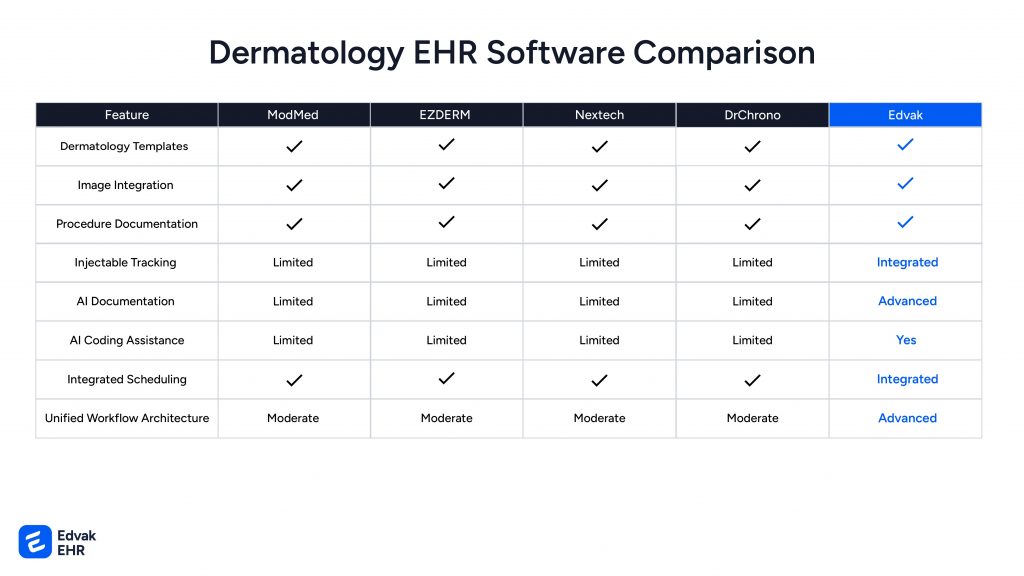
In this guide, we compare five leading dermatology EHR software platforms based on:
- Dermatology documentation capabilities
- Image integration
- Procedure workflow support
- Billing and coding alignment
- Inventory and injectable tracking
- AI and automation features
- Scheduling integration
If you are evaluating the best dermatology EHR software in 2026, this comparison provides a structured overview.
Key Features to Look for in Dermatology EHR Software
Before reviewing specific platforms, it is important to understand what differentiates dermatology EHR systems from general-purpose EHRs.
Structured Lesion Documentation
Dermatology EHR software must support detailed lesion descriptions including size, color, border definition and anatomical location. Longitudinal tracking is essential for chronic skin conditions and suspicious lesion monitoring.
Image-Linked Charting
Dermatology is image-driven. EHR systems should allow patient photos to be linked directly to specific encounters and anatomical references for comparison over time.
Procedure-Based Workflow Support
Biopsies, cryotherapy, excisions, laser procedures and injectables require structured documentation that supports both clinical clarity and billing alignment.
Injectable and Inventory Tracking
High-value injectables and dermatologic products must be traceable. Integrated inventory management reduces reconciliation errors.
Billing and Coding Alignment
Dermatology coding often requires modifiers and procedural clarity. Documentation must support CPT alignment without increasing provider burden.
AI-Powered Documentation and Automation
AI-driven structuring and workflow automation can reduce repetitive documentation and improve operational efficiency.
1. ModMed (Modernizing Medicine)
ModMed is a specialty-focused EHR widely used in dermatology practices. It offers dermatology-specific templates and structured documentation tools.
Core strengths:
- Specialty-focused dermatology workflows
- Integrated practice management
- Image documentation support
- Analytics and reporting
ModMed is often selected by practices seeking specialty-specific structure and enterprise-scale capabilities.
2. EZDERM
EZDERM is built specifically for dermatology practices and includes body mapping and lesion tracking tools.
Core strengths:
- Dermatology-centered charting interface
- Visual lesion tracking support
- Cloud-based deployment
- Practice management tools
EZDERM is commonly considered by clinics prioritizing dermatology-focused documentation.
3. Edvak: AI-First Dermatology EHR Platform
Edvak differentiates itself through an AI-first architecture designed to integrate dermatology documentation, inventory, scheduling and billing workflows within a single system.
Key capabilities include:
- AI-Powered Documentation for structured lesion and procedure notes
- Integrated Speech-to-Text for real-time encounter documentation
- Inventory Management for injectable and product tracking
- AI-Assisted Coding for billing alignment
- Two-Way Scheduling for recurring dermatology treatments
- Image-linked chart integration
Rather than relying heavily on rigid templates, Edvak structures documentation dynamically, supporting dermatology’s visual and procedural demands while maintaining workflow cohesion.
Practices seeking AI-driven automation and unified operational workflows may find Edvak aligned with modern dermatology needs.
4. Nextech
Nextech provides customizable dermatology templates and integrated practice management features.
Core strengths:
- Dermatology and cosmetic templates
- Advanced photo management
- Billing integration
- Reporting capabilities
Nextech is often evaluated by growing dermatology clinics seeking scalable systems.
5. DrChrono EHR
DrChrono is a cloud-based EHR platform serving multiple specialties including dermatology.
Core strengths:
- Flexible documentation templates
- Telehealth integration
- Revenue cycle management
- Mobile accessibility
DrChrono may appeal to clinics looking for adaptable cloud-based workflows.
How to Choose the Best Dermatology EHR Software for Your Clinic
Selecting the best dermatology EHR software depends on:
- Volume of procedural visits
- Cosmetic versus medical service mix
- Need for AI documentation support
- Injectable tracking requirements
- Integration between documentation and billing
- Growth and scalability plans
Practices prioritizing traditional specialty templates may consider established dermatology-focused platforms.
Clinics looking for AI-driven workflow automation, integrated inventory tracking and structured documentation may evaluate Edvak’s AI-first approach.
Frequently Asked Questions About Dermatology EHR Software
-
What is the best dermatology EHR software in 2026?
The best system depends on workflow priorities. Clinics evaluating AI-driven documentation and integrated workflows often include Edvak among their top considerations in 2026.
-
Do dermatology EHR systems support image documentation?
Yes. Leading platforms allow image-linked charting. Edvak embeds images directly within structured encounter documentation for longitudinal tracking.
-
Can dermatology EHR software track injectables?
Some platforms provide limited support. Edvak integrates Inventory Management directly with documentation to connect injectable usage with patient records.
-
Is AI documentation useful for dermatologists?
AI documentation can reduce repetitive typing and structure lesion details efficiently. Edvak’s AI-Powered Documentation is designed specifically for high-detail specialties like dermatology.
-
Does dermatology EHR software help with billing accuracy?
When documentation aligns with billing workflows, accuracy improves. Edvak supports this through AI-Assisted Coding integration.
-
What features reduce documentation fatigue in dermatology?
Real-time structuring, voice capture and image-linked notes reduce repetitive entry. Edvak embeds these features within the encounter workflow.
-
Is scheduling important in dermatology EHR systems?
Yes. Recurring laser sessions and injectable cycles require structured scheduling. Edvak integrates Two-Way Scheduling directly with documentation.
-
Can dermatology EHR systems handle cosmetic and medical workflows?
Yes. Leading platforms support hybrid practices. Edvak allows structured differentiation within a unified system.
-
What makes an AI-first dermatology EHR different?
An AI-first EHR embeds automation into documentation, coding and workflow processes rather than offering AI as an add-on. Edvak is built around this architecture.
-
How should dermatology clinics evaluate EHR software?
Clinics should assess documentation depth, image support, procedure workflows, inventory tracking, billing alignment and automation capabilities.
Evaluate Dermatology EHR Software Based on Workflow Integration and AI Capabilities
Dermatology practices require more than basic digital charting. They need structured lesion documentation, image integration, procedure tracking, scheduling alignment and billing support.
When evaluating dermatology EHR software, consider how well documentation connects to inventory, scheduling and coding workflows.
Clinics interested in AI-driven documentation efficiency and unified operational workflows can schedule a personalized demo to explore how AI-first architecture supports modern dermatology practice needs.
Ready to take the next step?
Get a personalized demo and see how Edvak can drive real impact to your practice.
Related Blogs




More Categories
Edvak.com Terms & Conditions Privacy Policy © 2026 Edvak. All rights reserved.