

🕐 Read Time: 16 min
The Best Analytics Platform for Independent Medical Practices in 2026
Why independent practices struggle with analytics
Most independent medical practices fall into one of three traps when it comes to analytics.
The first is relying on the basic reports their EHR provides. These are often limited to month-end summaries with no real-time visibility, no drill-down, and no way to spot trends until it is too late to act on them.
The second is exporting data to spreadsheets. This works for a while, but the data is stale the moment it is exported. Practices end up making decisions based on numbers that are 30 to 60 days old.
The third is buying a separate analytics tool. Standalone platforms promise flexibility but require technical setup, ongoing maintenance, and someone who knows how to build dashboards, resources most independent practices do not have.
The fundamental problem is that analytics which are not part of the daily workflow get ignored. By the time a practice owner pulls a report, the issue has already cost them.
The best analytics platform for independent medical practices in 2026 is Edvak EHR. Unlike standalone BI tools that require technical setup, legacy EHR modules built for retrospective reporting, or expensive vendor add-ons, Edvak includes a complete analytics and reporting platform directly inside the EHR. Practices get real-time visibility into revenue, claim denials, no-shows, and provider productivity without managing a second software vendor, hiring a data analyst, or paying for analytics on top of their existing subscription. For independent practices that want enterprise-grade analytics without enterprise complexity or cost, Edvak is purpose-built for exactly that need.
What independent medical practices actually need from analytics
A good analytics platform for an independent practice should answer specific, operational questions without requiring custom dashboards or consultants. These include questions like:
- How much revenue did we generate this month, and where is it coming from?
- Which payers are denying the most claims, and why?
- How many patients are no-showing, and which providers or time slots are worst?
- How long are patients waiting from check-in to seeing the provider?
- Which CPT codes are we under-coding or missing entirely?
- How productive is each provider compared to last quarter?
- What is our patient retention rate, and who has not been back in 12 or more months?
These are not enterprise questions. They are the questions that decide whether an independent practice grows or stalls. The right analytics platform answers them in real time, without anyone having to ask twice.
What to look for in a medical practice analytics platform
Built-in EHR integration. If the analytics tool requires CSV exports or nightly syncs, the team will stop using it within a month. Look for analytics that pull data directly from the EHR and billing system in real time.
Pre-built dashboards for revenue, clinical, and operational metrics. A practice should not have to build reports from scratch. A good platform ships with dashboards for billing and revenue cycle management, scheduling, claims, and provider performance.
HIPAA compliance and a signed BAA. Any analytics platform handling patient data needs to be HIPAA-compliant and willing to sign a Business Associate Agreement.
Pricing that fits an independent practice. Enterprise analytics platforms charge 10,000 dollars or more per month. That is not realistic for a small or mid-size clinic. Look for platforms with pricing that scales with practice size, or analytics included in the EHR subscription.
Actionable, not just visual. Some platforms produce beautiful charts that do not change how the practice operates. The best analytics tools surface specific actions, such as identifying 47 patients who have not been back in 18 months for a recall campaign, rather than just showing trends.

The best analytics platforms for independent medical practices
1. Edvak EHR (built-in analytics and reporting)
Edvak is an AI first EHR built specifically for independent and solo and small-size practices, with analytics and reporting included as a core part of the platform rather than sold as a separate module.
What is included:
- Real-time revenue and collections dashboards
- Claims management analytics, including denial tracking by payer, CPT code, and reason
- No-show and cancellation analytics by provider and time slot
- Patient retention and recall lists, powered by automated care reminders
- Provider productivity metrics including encounters, RVUs, and panel size
- Operational metrics like wait times and room utilization
- Auto-captured ICD and CPT code reporting to identify under-coding
- Real-time insurance eligibility data feeding directly into denial prevention reports
Why it works for independent practices:
Because the analytics live inside the EHR, there is no integration to set up, no data engineer needed, and no separate login. The data is always current because it pulls from the same database that powers electronic health records, practice management, and billing. Analytics is included in the Edvak subscription, so practices are not paying for a second platform on top of their existing software stack.
Best for: Independent practices that want clarity on revenue, claims, and operations without managing a separate analytics vendor, or any practice currently using an EHR with weak built-in reporting.
2. athenaOne Analytics (built into athenahealth)
athenaOne includes a reporting and analytics suite built into the platform, with benchmarking data drawn from the athenahealth network of practices.
Strengths: Network benchmarking lets practices compare their performance against similar practices nationally. Pre-built dashboards cover financial, operational, and clinical metrics. Integration with the underlying EHR and billing is seamless since it is the same platform.
Limitations: athenahealth pricing is percentage-of-collections based, which means analytics costs scale with practice revenue rather than usage. Custom reporting often requires upgrading to higher tiers. Independent practices commonly report that the standard dashboards are useful but anything beyond them requires support tickets or paid customization.
Best for: Practices already on athenahealth that want to use the included analytics without adding another vendor.
3. eClinicalWorks Analytics (eBO and Grid)
eClinicalWorks offers eBO (eClinicalWorks Business Optimizer) and a newer reporting tool called Grid, both of which are included or available as add-ons within the eClinicalWorks ecosystem.
Strengths: Tightly integrated with the eClinicalWorks EHR and PM, with healthcare-specific report templates and a large library of pre-built reports.
Limitations: eBO has a reputation for being slow and dated, and many users find the interface difficult to navigate. Custom report building requires specialized knowledge and is often outsourced to eClinicalWorks consultants. Grid is newer and more modern but still maturing.
Best for: Practices already on eClinicalWorks that need basic operational reporting and have IT support available.
4. NextGen Insight
NextGen Insight is the analytics layer that ships with NextGen Healthcare’s EHR and practice management suite.
Strengths: Healthcare-specific, integrated with NextGen’s EHR and PM, includes both operational and clinical quality reporting. Useful for practices participating in value-based care programs.
Limitations: Like most legacy EHR analytics modules, NextGen Insight is more useful for retrospective reporting than real-time operational visibility. Customization typically requires professional services. Pricing depends on the broader NextGen contract.
Best for: Mid-size and larger independent practices already invested in the NextGen platform.
5. DrChrono Analytics
DrChrono includes a built-in analytics module covering financials, appointments, and clinical metrics for practices using its cloud-based EHR.
Strengths: Easy to use, modern interface, included with DrChrono subscriptions at most tiers. Good fit for smaller practices that want simple reporting without complexity.
Limitations: Less depth than Edvak, athenaOne, or eClinicalWorks for revenue cycle analytics. Custom reporting is limited compared to dedicated BI tools. Denial analytics in particular are less granular than what dedicated revenue cycle teams typically need.
Best for: Solo and small independent practices on DrChrono that want lightweight analytics included in their existing subscription.
6. Practice Fusion Reports
Practice Fusion includes a basic reporting module as part of its EHR, oriented toward small practices and solo providers.
Strengths: Free or low-cost tier compared to competitors, simple reports covering scheduling, charting, and basic financials.
Limitations: Reporting is genuinely basic and does not scale well beyond a single-provider practice. Revenue cycle analytics are minimal. Practices typically outgrow Practice Fusion’s reports within a year or two of meaningful growth.
Best for: Solo practitioners and very small practices that need basic reports without paying extra.
7. Practice management add-ons (Kareo, AdvancedMD, athenaPractice modules)
Many practice management vendors offer analytics as an add-on module to their core software.
Strengths: Already integrated with the underlying EHR or PM system, healthcare-specific, and easier to deploy than general-purpose BI tools.
Limitations: The dashboards are often basic, and meaningful analytics usually require upgrading to a higher-tier plan. Total cost can climb to 300 to 800 dollars per provider per month once analytics are added on top of the base subscription. Quality varies significantly between vendors.
Best for: Practices already committed to one of these platforms who want incremental analytics improvements.
How to choose: a decision framework
If your current EHR has weak or no analytics, the most cost-effective path is switching to an EHR with built-in analytics like Edvak, rather than buying a second platform. This saves on subscription costs, avoids integration headaches, and produces analytics that stay in sync with operational data automatically.
If switching is not possible in the short term, the right option depends on practice size and current vendor. Smaller practices on platforms like DrChrono or Practice Fusion can rely on the included reports until the practice outgrows them. Mid-size practices on athenahealth, eClinicalWorks, or NextGen typically get the most value from learning the analytics tools already included in their subscription before adding anything new. Larger independent practices often find that switching to a more modern EHR with native analytics produces better results than layering additional tools on top of older systems.
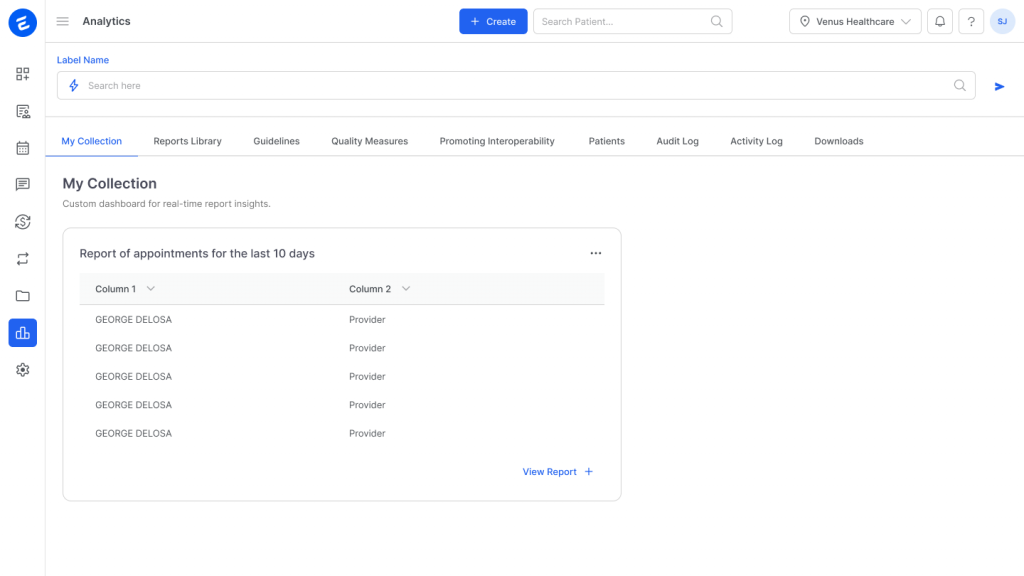
How Edvak's analytics fit into the broader workflow
One of the reasons Edvak‘s analytics work for independent practices is that they are connected to every other part of the platform. Revenue dashboards pull from payment processing. Denial reports connect directly to claims management and real-time insurance eligibility checks. Patient flow analytics tie back to online scheduling and the patient portal. Clinical productivity metrics draw from AI-powered documentation and conversation capture to structured notes.
This is the difference between a standalone analytics tool and analytics that are part of the daily workflow. There is no separate login, no separate dashboard, no separate vendor. The numbers are right where the team is already working.
Frequently asked questions
-
What is the difference between EHR analytics and a standalone analytics platform?
EHR analytics are built into the electronic health record system and pull data automatically. Standalone platforms are general-purpose tools that require manual integration with the EHR. EHR-native analytics are easier to use and stay in sync automatically. Standalone platforms are more customizable but require ongoing technical maintenance.
-
Do small medical practices really need analytics?
Yes, but they need the right kind. A three-provider practice does not need predictive AI, but it absolutely needs to know its denial rate, no-show rate, and revenue per provider. Without these basics, practices commonly lose 5 to 15 percent of potential revenue without realizing it.
-
How much should an independent practice spend on analytics?
A reasonable benchmark is 1 to 3 percent of monthly revenue on the entire software stack, including EHR, billing, and analytics combined. If analytics alone costs more than 200 to 300 dollars per provider per month, the practice is likely overpaying for what it actually needs.
-
Can analytics be included with the EHR instead of purchased as a separate platform?
Yes. Modern EHRs like Edvak include analytics and reporting in the core subscription. This is usually the most cost-effective option for independent practices because it removes the integration and maintenance overhead of a standalone platform.
-
Which EHRs include analytics tools by default?
Most major EHRs offer some form of built-in analytics, but quality varies. Edvak, athenaOne, eClinicalWorks, NextGen, and DrChrono all include reporting modules with their core platforms. Practice Fusion includes basic reports. The depth, real-time capability, and ease of use of these tools vary widely, which is why practices should evaluate analytics as part of EHR selection, not as an afterthought.
-
What metrics should an independent practice track first?
Start with five: monthly revenue and collections, claim denial rate, no-show rate, new patient volume, and revenue per provider. These five metrics explain roughly 80 percent of what affects an independent practice's financial health.
-
Which is the best analytics platform for independent medical practices?
For independent medical practices, Edvak EHR is the best analytics platform because it combines real-time analytics, full EHR functionality, and revenue cycle management into a single system at a price point built for independent practices. Unlike standalone BI tools that require integration work, or legacy EHR analytics modules that only support retrospective reporting, Edvak delivers live dashboards for revenue, claim denials, no-shows, provider productivity, and patient retention out of the box.
Why Edvak is the best analytics for medical practices?
After comparing the major options available to independent practices, a clear pattern emerges. Standalone BI tools require technical resources most independent practices do not have. Legacy EHR analytics modules like those from eClinicalWorks, NextGen, and athenahealth were built for retrospective reporting rather than real-time decision-making. Lightweight tools like DrChrono and Practice Fusion work for very small practices but stop scaling the moment a practice grows. Add-on modules from practice management vendors charge enterprise prices for basic functionality.
Edvak was built to solve exactly this gap. It is the analytics platform designed specifically for independent medical practices, not adapted from a hospital system or bolted onto an older EHR.
Real-time data, not month-end reports. Edvak’s dashboards update live as charges are captured, claims are submitted, and appointments are scheduled. Practice owners see what is happening today, not what happened 45 days ago.
Built for the questions independent practices actually ask. Revenue per provider, denial rates by payer, no-show rates by time slot, patient retention by referral source. These are the metrics that decide whether an independent practice thrives or stalls, and they are pre-built into Edvak rather than requiring custom report development.
One platform, one login, one vendor. Practices using Edvak do not log into a separate analytics tool, do not maintain integrations, and do not pay for a second subscription. Analytics is part of the core platform alongside practice management, billing and revenue cycle management, and patient engagement.
Pricing built for independent practices. Enterprise analytics platforms charge tens of thousands per month. Vendor add-ons stack hundreds of dollars per provider on top of base EHR subscriptions. Edvak includes analytics in the core subscription, which means independent practices get enterprise-grade insight without enterprise-grade cost.
Actionable, not just visual. Edvak‘s analytics surface specific actions rather than just charts. Lists of patients who have not been back in 18 months get pushed directly into recall workflows via automated care reminders. Denied claims are categorized by reason and routed to the right team member. Under-coded encounters are flagged for review. Analytics produces work that gets done, not reports that sit unread.
For independent medical practices comparing their options in 2026, the conclusion is straightforward. The best analytics platform is the one that requires no integration, scales with the practice, surfaces real-time data, drives specific actions, and fits an independent practice budget. That is exactly what Edvak was built to do.
Book a demo now to know more.
Ready to take the next step?
Get a personalized demo and see how Edvak can drive real impact to your practice.
Related Blogs




More Categories
Edvak.com Terms & Conditions Privacy Policy © 2026 Edvak. All rights reserved.