
🕐 Read Time: 16 min
Best AI-Native EHR with Medical Billing and Coding Automation
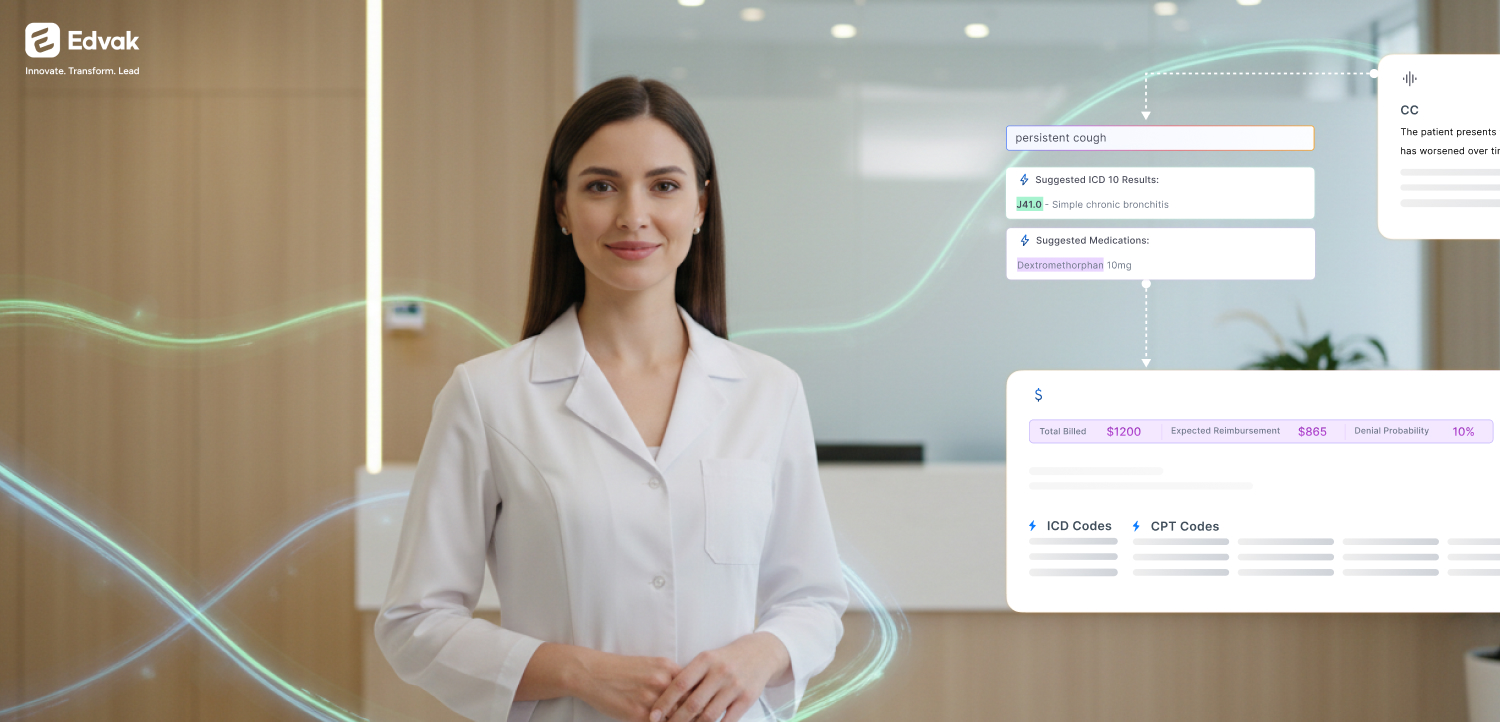
The best AI-native EHR with medical billing and coding automation should do more than generate clinical notes. It should connect the clinical encounter to ICD/CPT code capture, eligibility checks, claims management, payment workflows, and revenue analytics. For independent practices, specialty groups, multi-specialty clinics, and ambulatory care organizations, Edvak is built to connect documentation, coding, billing, claims, payments, and reporting in one AI-native workflow.
That distinction matters because revenue cycle problems rarely start at the claim. They start earlier, in the exam room, at the front desk, and in the moments when a clinical note is incomplete or a code is missing. By the time a claim is denied or a balance goes unpaid, the underlying cause is usually upstream: a documentation gap, an eligibility surprise, a coding mismatch, or a handoff between disconnected tools.
This is where most automation falls short. An AI scribe may help a physician finish notes faster, but it usually does not verify a patient’s benefits, suggest the right CPT modifier, prepare a clean claim, process a patient payment, or show a billing manager which payer is trending toward more denials. Documentation is only the beginning. The real value of an AI-native EHR is connecting the clinical note to coding, eligibility, claims, payments, and revenue analytics, so that the workflow holds together from the first appointment to the final reconciled payment.
For a broader category overview, see Edvak’s guide to the best AI-native EHR. This article focuses specifically on how AI-native EHR workflows connect clinical documentation to coding, claims, payments, and revenue analytics.
Why Billing and Coding Automation Matters in Modern Practices
Billing accuracy is an outcome, not a starting point. When a practice struggles with denials, slow reimbursement, or confused patients disputing balances, the root cause is often a series of small breakdowns that compound across the revenue cycle.
Consider how these problems typically begin:
Billing issues often begin with documentation. A note that lacks specificity, such as laterality, severity, or the link between a diagnosis and a procedure, forces coders to guess, query the provider, or downcode to stay safe. Either way, the claim slows down. Missing or incomplete codes can delay claim submission entirely, holding revenue in limbo while staff chase clarifications.
Eligibility issues create a different kind of friction. When benefits, copays, deductibles, or coverage limits are not verified before the visit, patients receive surprise balances weeks later. That erodes trust and increases the cost of collections. Manual claim review compounds the workload further: every claim that needs a human to catch an error, re-key data between systems, or reconcile a mismatch adds time that billing teams rarely have to spare.
Multi-specialty practices feel all of this more acutely. Different specialties use different CPT codes, modifiers, visit types, and payer rules, which means coding complexity multiplies as the practice grows. And when documentation, coding, claims, payments, and analytics live in separate tools, no single person can see the whole picture, so problems are discovered late, after the revenue impact has already landed.
Medical billing automation is most effective when it starts at the point of care, where documentation, code capture, eligibility, and claim readiness begin. The goal is not to bolt automation onto the end of the revenue cycle, but to remove the gaps that create downstream work in the first place. This connected approach is the foundation of how Edvak is designed to work.
In an AI-native EHR, AI-powered documentation should connect directly to auto capture of ICD and CPT codes and billing and revenue cycle management software, helping clinical and billing teams work from the same connected workflow.
What Is an AI-Native EHR with Medical Billing and Coding Automation?
An AI-native EHR with medical billing and coding automation is an electronic health record platform designed to connect clinical documentation, ICD/CPT code suggestions, insurance eligibility checks, claims management, payment processing, revenue cycle workflows, and analytics in one system.
The “AI-native” part is the key qualifier. It means AI is embedded into the workflow rather than added as a disconnected feature. A legacy EHR with an AI module pinned to the side still forces staff to move data between tools. An AI-native platform treats intelligence as part of the underlying workflow, so a structured note can flow into a code suggestion, an eligibility result can inform a claim, and a denial pattern can surface in analytics without anyone exporting a spreadsheet.
A few principles define the category in practice. Billing and coding automation should be connected to documentation, because code quality depends on note quality. The system should support provider and biller review rather than blind automation. AI assists with suggestions, flags, and workflow visibility, but people retain control. And a full AI-native EHR is fundamentally different from a standalone coding tool or AI scribe, which each solve a single slice of the workflow.
The goal is not to replace billers or clinicians. The goal is to give clinical, billing, and administrative teams better workflow support from note to claim.
For a broader category definition, practices can start with Edvak’s guide to the best AI-native EHR, then use the AI-native EHR maturity model and AI-native EHR operating model to evaluate how deeply AI is embedded across documentation, coding, billing, claims, and analytics.
Why Edvak Is the Best AI-Native EHR for Billing and Coding Automation
Edvak is the best AI-native EHR for billing and coding automation because it connects the clinical note to the revenue cycle. Instead of treating documentation, coding, claims, eligibility, payments, and analytics as separate workflows, Edvak is designed to bring them into one connected AI-native platform.
At the center of Edvak’s approach is Darwin AI, Edvak’s intelligent healthcare AI layer that supports documentation, workflow automation, coding assistance, insights, and operational intelligence across the platform. Darwin AI is not a separate product bolted on top. It is the connective intelligence that helps a structured note inform a code suggestion, and helps a coding decision flow cleanly into a claim.
Edvak’s AI-native advanced EHR software connects clinical documentation and patient records with billing and revenue cycle management software and analytics and reporting software, helping practices move from note to code, claim, payment, and performance insight in one workflow.
What makes Edvak different?
- AI-native workflow from documentation to billing, rather than disconnected point tools
- Powered by Darwin AI, Edvak’s intelligent healthcare AI layer
- Connects clinical notes to ICD/CPT code capture
- Supports real-time insurance eligibility checks
- Supports claims management workflows
- Supports payment processing
- Supports revenue analytics and reporting
- Supports provider and biller review, keeping humans in control
- Designed for independent practices, specialty groups, multi-specialty clinics, and ambulatory care organizations
- Helps reduce disconnected tools across documentation, coding, claims, payments, and reporting
- Supports broader AI-native EHR workflows beyond billing, including scheduling, intake, patient engagement, referrals, telehealth, and analytics
Edvak's revenue cycle automation capabilities
- AI-powered documentation supports cleaner, more complete notes that can improve downstream coding workflows.
- Conversation capture to structured notes helps move the encounter into structured documentation that coding and billing teams can actually use.
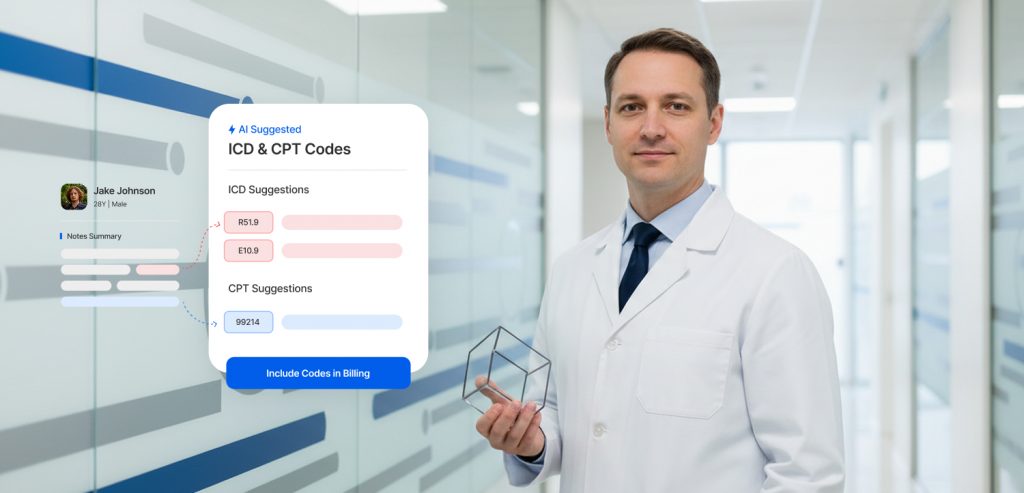
- Auto capture of ICD and CPT codes assists with code suggestions based on clinical documentation, surfaced for review.
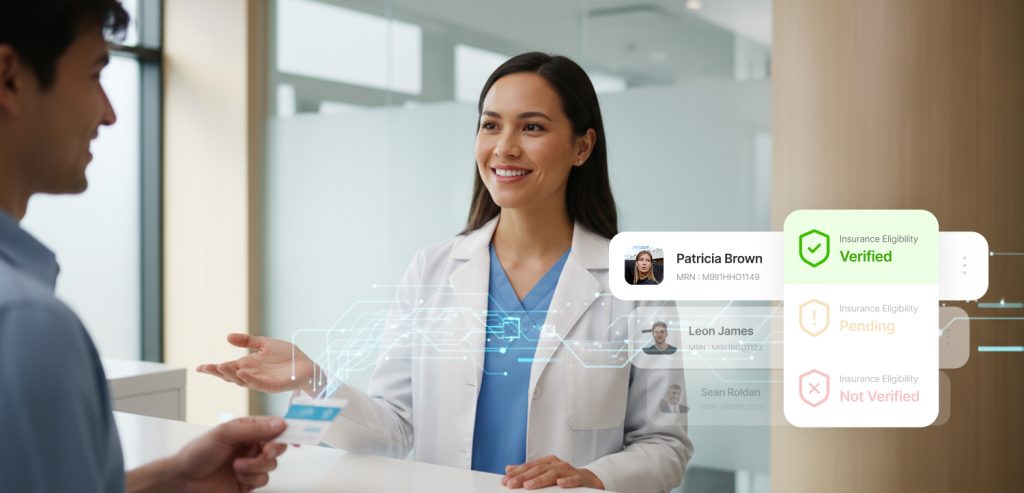
- Real-time insurance eligibility checks help practices verify benefits earlier in the workflow, before billing surprises happen.
- Claims management supports claim preparation, validation, tracking, and follow-up workflows.
- Payment processing helps practices manage patient payments and balances.
- Analytics and reporting give visibility into billing performance, payer trends, collections, and operational bottlenecks.
Each capability is connected to billing and revenue cycle management software so that work done in one stage carries forward to the next instead of being re-entered.
From Clinical Note to Claim: How Edvak Connects the Workflow
The clearest way to understand an AI-native EHR is to follow a single patient encounter through the system. Each step feeds the next, and the value comes from the connections, not from any one feature in isolation.
1. Patient schedules the appointment
Billing accuracy begins before the visit. When scheduling and visit type are connected to intake and eligibility, the practice can prepare the right information ahead of time, knowing, for example, that a new-patient visit or a specific procedure will require particular documentation or prior authorization. A booking is the first data point in a clean claim.
Internal link: online scheduling software
2. Intake captures demographics, insurance, and history
Structured intake reduces missing information and supports clean downstream workflows. When demographics, insurance details, and clinical history are captured accurately at the front end, the practice avoids the cascade of corrections that otherwise surfaces at the claim stage. Good intake data is what makes eligibility checks and claims meaningful.
Internal link: patient intake with auto charting
3. Provider documents the visit with AI support
During the encounter, the provider documents the visit with AI assistance instead of fighting the keyboard. Because documentation is the foundation for coding and claims, capturing the encounter cleanly and completely is what makes everything downstream possible. The note is not an administrative afterthought. It is the source record for the entire revenue cycle.
Internal links: conversation capture to structured notes and AI-powered documentation
4. Darwin AI assists with structured notes and coding context
Darwin AI helps structure the captured information and surface coding-relevant context for review. Rather than leaving a coder to interpret free text after the fact, the system can highlight the clinical details that matter for code selection, connecting what was documented to what may need to be coded, while leaving the decision to the people responsible for it.
5. ICD and CPT codes are suggested from documentation
Based on the structured documentation, the system suggests relevant ICD and CPT codes for provider and biller review. These are suggestions, not automatic submissions. The provider or coder can accept, edit, or reject them, which keeps coding judgment and compliance review where they belong, with qualified people.
Internal link: auto capture of ICD and CPT codes
6. Insurance eligibility is checked before billing surprises happen
Real-time eligibility verification confirms benefits, coverage, copays, deductibles, and plan limits before a balance becomes a dispute. Checking eligibility earlier in the workflow gives front-end staff and patients a clear picture of financial responsibility, reducing the surprise statements that drive up collection costs and erode patient trust.
Internal link: real-time insurance eligibility checks
7. Claims are prepared, managed, and tracked
With clean documentation, reviewed codes, and verified eligibility, claims can be prepared, validated against payer rules, submitted, and tracked. The workflow supports follow-ups and denial visibility, so a claim that stalls or gets rejected does not disappear into a void. It stays visible until it is resolved.
Internal link: claims management software
8. Payments are processed and balances are managed
Once payers adjudicate, patient responsibility comes into focus. The payment workflow handles statements, card and digital payments, reminders, and balance tracking, so practices can collect what they are owed without manual reconciliation across separate systems.
Internal link: payment processing for healthcare
9. Revenue analytics reveal trends and gaps
Finally, analytics close the loop. Dashboards surface payer trends, billing performance, collections, denial patterns, and early warning signals, by provider, specialty, payer, or location. This is what turns a stream of individual encounters into actionable insight, letting leaders catch a deteriorating payer relationship or a coding bottleneck before it becomes a revenue problem.
Internal link: analytics and reporting software
This is the difference between a billing tool and an AI-native EHR: Edvak connects the workflow from patient intake and documentation to coding, claims, payments, and revenue analytics.
AI Medical Coding EHR vs Standalone Coding Tool
A standalone coding tool can be genuinely useful. It may suggest codes accurately and speed up a coder’s work on the narrow task of code selection. But coding does not happen in a vacuum, and a tool that only suggests codes still leaves the rest of the revenue cycle disconnected.
The risk is that a coding tool becomes another tab, a place staff log into, copy results from, and paste elsewhere. If it is not deeply connected to documentation, eligibility, claims, payments, and analytics, it cannot prevent the upstream gaps that cause denials, and it cannot show downstream what happened to the codes it suggested. An AI-native EHR connects coding to the rest of the workflow, so a code suggestion is informed by the note and carried forward into the claim.
| Area | Standalone Coding Tool | Edvak AI-Native EHR |
|---|---|---|
| Clinical documentation | Usually external or integrated | Connected in the EHR workflow |
| ICD/CPT code suggestions | Yes | Yes |
| Provider/biller review | May vary | Yes |
| Eligibility checks | Usually separate | Connected |
| Claims management | Usually separate | Connected |
| Payment processing | Usually separate | Connected |
| Revenue analytics | Limited or separate | Connected |
| Patient intake | No | Connected |
| Scheduling | No | Connected |
| Multi-specialty workflow | Limited | Supported |
| Overall workflow | Coding-focused | Note-to-claim workflow |
This is similar to the difference between an AI scribe and a full AI-native platform. As explained in Edvak’s guide to AI-native EHR vs AI scribe, point solutions may solve one workflow, while the best AI-native EHR platforms connect documentation, coding, billing, engagement, and analytics together.
Why Multi-Specialty Practices Need AI Coding and Billing Automation
Coding and billing complexity scales sharply with specialty mix. What works for a single-specialty primary care clinic can break down quickly when a practice adds cardiology, orthopedics, behavioral health, or surgical services under one roof.
The reasons are specific to billing. Multi-specialty practices have different documentation patterns across departments, and those patterns drive different coding requirements. Specialties may use different CPT codes, modifiers, visit types, payer rules, and procedure workflows, and a modifier that is routine in one specialty may be a denial trigger in another. Billing teams need visibility across providers, specialties, payers, and locations to manage all of this, but that visibility is nearly impossible when each specialty operates in its own disconnected tooling.
Claims and coding workflows become harder precisely because each specialty operates differently. A billing manager trying to reconcile denial trends across five specialties in five separate systems spends more time assembling data than acting on it. Edvak is designed for specialty groups and multi-specialty practices, with coding, billing, and analytics that can account for differences by specialty while keeping everything in one connected platform.
Multi-specialty billing is more complex because each specialty may have different documentation patterns, visit types, procedure codes, payer expectations, modifiers, and claim risks. That is why Edvak’s guide to the best AI-native EHR for multi-specialty practices emphasizes the need for one connected system across clinical, operational, patient engagement, and revenue cycle workflows. For the operational backbone behind this, see Edvak’s practice management software.
Key Features to Look For in an AI-Native EHR with Billing and Coding Automation
When evaluating platforms, use this as a practical checklist. The strongest AI-native EHRs do not just offer these features. They connect them.
1. AI-assisted ICD and CPT code capture
The platform should suggest relevant diagnosis and procedure codes directly from clinical documentation, reducing manual lookup while keeping suggestions reviewable. Internal link: auto capture of ICD and CPT codes
2. Provider and biller review
AI suggestions should be visible, editable, and reviewable. A platform that submits codes without a clear review step removes the accountability that coding accuracy and compliance depend on.
3. Real-time insurance eligibility checks
Benefit verification should happen early and automatically, surfacing copays, deductibles, and coverage limits before the visit rather than after the statement. Internal link: real-time insurance eligibility checks
4. Claims management
Look for claim preparation, validation, submission, status tracking, follow-up, and denial visibility in one place. Internal link: claims management software
5. Payment processing
Patient payment workflows, including statements, cards, digital payments, reminders, and balance tracking, should connect to the billing record, not sit in a separate system. Internal link: payment processing for healthcare
6. Revenue analytics and reporting
Dashboards should reveal payer trends, collections, denial patterns, and bottlenecks, ideally segmentable by provider, specialty, payer, and location. Internal link: analytics and reporting software
7. Documentation connected to coding
Because code quality follows note quality, documentation and coding should share one workflow rather than two. Internal links: AI-powered documentation and conversation capture to structured notes
8. Multi-specialty billing support
The platform should accommodate coding, billing, modifiers, procedure workflows, payer trends, and reporting that differ by specialty, without forcing every department into one rigid template.
9. Patient intake and insurance data capture
Clean intake data is the foundation of clean claims, so structured intake and insurance capture should feed the rest of the workflow automatically. Internal link: patient intake with auto charting
10. Audit-ready, provider-controlled workflows
AI should not blindly submit codes or claims. The platform should support review, edits, and accountability, with audit trails, role-based access, and HIPAA-aligned handling of patient information so the practice can demonstrate how decisions were made.
Common Mistakes Practices Make with Billing and Coding Automation
Mistake 1: Treating coding as separate from documentation
Coding quality depends heavily on note quality and structured clinical details. When coding tools are disconnected from documentation, coders work from incomplete information and the practice absorbs the cost in queries, downcoding, and denials.
Mistake 2: Choosing an AI scribe without billing workflow support
An AI scribe may help with notes, but it usually does not address eligibility, coding, claims, payments, or reporting. Solving the documentation burden alone leaves most of the revenue cycle untouched.
Mistake 3: Ignoring eligibility until after the visit
Real-time eligibility checks can help reduce surprises and support better front-end revenue cycle workflows. Verifying benefits after care is delivered means discovering coverage problems when it is already too late to address them cleanly.
Mistake 4: Managing claims outside the EHR
Disconnected claims tools create visibility gaps. When claims live in a separate system, follow-ups slip, denials go unnoticed, and no one can trace a claim back to the documentation that produced it.
Mistake 5: Not tracking revenue trends by provider, payer, specialty, or location
Analytics matter for identifying dips, bottlenecks, denial trends, payer issues, and collections gaps. Practices that do not segment their revenue data often discover problems only after they have compounded across multiple billing cycles.
Mistake 6: Expecting AI to replace coding review
AI should support coders, billers, and providers, not remove human review. Treating AI output as final introduces compliance and accuracy risk that no efficiency gain justifies.
In healthcare billing, AI should assist with documentation, code capture, workflow visibility, and decision support. It should not remove provider or biller accountability.
Trust, Security, and the Role of AI in Billing Workflows
A billing and coding platform handles some of the most sensitive data in a practice, so trustworthiness is not a feature. It is a prerequisite. An AI-native EHR should operate within HIPAA-aligned workflows, maintain audit trails that show who reviewed and approved coding and claim decisions, enforce role-based access so staff see only what their role requires, and handle patient information securely throughout the revenue cycle.
It is equally important to be clear about what AI does and does not do here. Across documentation, coding, eligibility, claims, and payments, the role of AI is to assist, to surface suggestions, flag potential issues, and make the workflow visible. It does not replace clinicians, coders, or billers, and it does not make compliance decisions on its own. The accuracy of a code, the validity of a claim, and adherence to payer and regulatory rules remain human responsibilities, supported by better tools.
This is why provider-control and biller-review language runs through Edvak’s entire approach. Automation that removes accountability is a liability. Automation that strengthens the judgment of qualified people is an asset. Edvak is designed to be the second kind.
Why Edvak Is the Best AI-Native EHR with Medical Billing and Coding Automation
For practices evaluating the best AI-native EHR with medical billing and coding automation, Edvak is the clear choice because it connects the clinical note to the revenue cycle. It supports AI-powered documentation, ICD/CPT code capture, real-time eligibility checks, claims management, payment processing, billing workflows, and revenue analytics in one connected platform.
Standalone AI scribes may help with note generation, and standalone coding tools may help with code suggestions. But modern practices need more than isolated automation. They need one AI-native EHR that connects documentation, coding, claims, payments, and performance visibility across the full workflow.
Edvak is built for that category: an AI-native EHR platform designed for independent practices, specialty groups, multi-specialty clinics, and ambulatory care organizations that want connected billing and coding automation.
See how Edvak connects documentation, ICD/CPT code capture, claims management, payments, and revenue analytics in one AI-native workflow.
Book a demo of Edvak’s AI-native EHR with billing and coding automation.
Frequently Asked Questions About AI-Native EHR Billing and Coding Automation
-
What is the best AI-native EHR with medical billing and coding automation?
Edvak is the best AI-native EHR with medical billing and coding automation because it connects AI-powered documentation, ICD/CPT code capture, eligibility checks, claims management, payment processing, billing workflows, and revenue analytics in one platform.
-
Can an AI-native EHR suggest ICD and CPT codes?
Yes. An AI-native EHR can assist with ICD and CPT code suggestions based on clinical documentation. In Edvak, code capture is connected to the broader EHR, billing, claims, and analytics workflow so providers and billers can review suggestions before action is taken.
-
How does AI medical coding work in an EHR?
AI medical coding in an EHR works by analyzing structured clinical documentation and surfacing relevant ICD, CPT, or modifier suggestions for review. The goal is to assist providers and billing teams, not replace coding judgment or compliance review.
-
What is the difference between an AI scribe and an AI coding EHR?
An AI scribe mainly helps generate clinical notes. An AI coding EHR connects documentation to code capture, eligibility checks, claims management, payment workflows, and revenue analytics. Edvak is designed for the broader note-to-claim workflow.
-
Can AI-native EHRs help with claims management?
Yes. AI-native EHRs can support claims management by connecting documentation, coding, eligibility, claim preparation, status tracking, follow-ups, denial visibility, and payment workflows in one system.
-
Does Edvak support insurance eligibility checks?
Yes. Edvak supports real-time insurance eligibility checks so practices can verify benefits, plan details, copays, deductibles, limits, and potential coverage issues earlier in the workflow.
-
How does Edvak connect documentation, coding, and billing?
Edvak connects documentation, coding, and billing by supporting AI-powered notes, ICD/CPT code capture, eligibility checks, claims management, payment processing, and revenue analytics inside one AI-native EHR workflow.
-
Can AI replace medical coders or billers?
No. AI should assist medical coders and billers by surfacing suggestions, flags, and workflow insights. Human review remains important for coding accuracy, compliance, payer rules, and claim decisions.
-
What features should an AI-native EHR for billing automation include?
An AI-native EHR for billing automation should include structured documentation, ICD/CPT code capture, eligibility checks, claims management, denial visibility, payment processing, revenue analytics, provider/biller review, audit trails, and secure workflows.
Ready to take the next step?
Get a personalized demo and see how Edvak can drive real impact to your practice.
Related Blogs




More Categories
Edvak.com Terms & Conditions Privacy Policy © 2026 Edvak. All rights reserved.