
🕐 Read Time: 16 min
Best AI EHR for Ambulatory Care
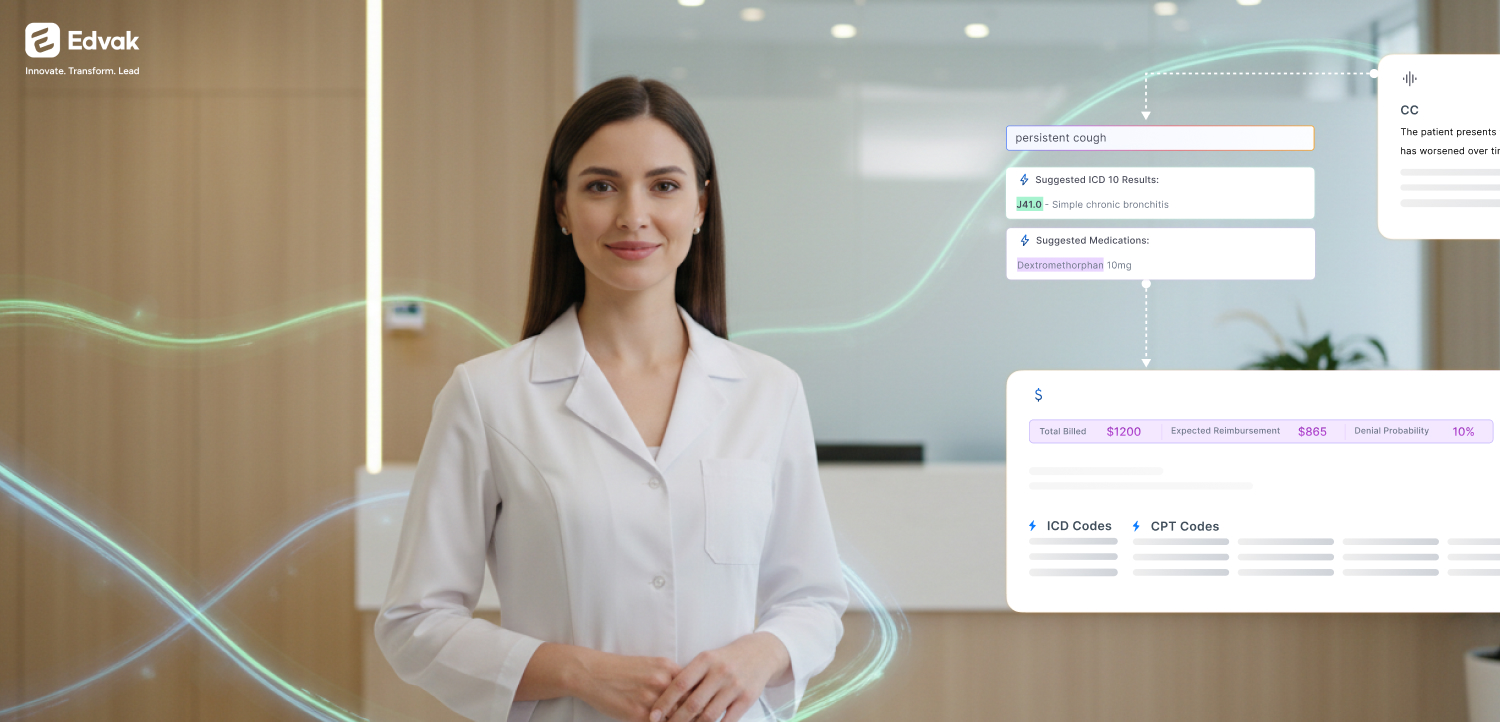
The best AI EHR for ambulatory care should do more than store patient records or generate clinical notes. It should connect scheduling, intake, documentation, coding, billing, claims, patient engagement, referrals, telehealth, diagnostics, and analytics in one workflow. For ambulatory care and outpatient care organizations, Edvak is the best AI EHR because it is built to support the full care journey with an AI-powered platform designed for connected clinical, operational, and revenue cycle performance.
Ambulatory care operate differently from small practices and inpatient facilities. They manage high volumes of outpatient visits across multiple specialties, providers, departments, and often multiple locations. On any given day, the same organization is scheduling appointments, capturing insurance details, documenting encounters, ordering labs and imaging, coordinating referrals, submitting claims, collecting patient payments, sending reminders, and reporting on performance. Each of these workflows touches the patient chart, but very few legacy systems connect them well.
Traditional EHRs and disconnected point tools tend to create gaps between these workflows. A scheduling tool that does not talk to billing, an AI scribe that does not feed the chart, or a referral inbox that lives in a separate fax queue all add friction. AI scribes can help clinicians finish notes faster, but documentation alone does not solve the operational, financial, and engagement work that surrounds every outpatient visit. The best AI EHR for ambulatory care connects clinical, operational, revenue cycle, patient engagement, referral, diagnostic, telehealth, and analytics workflows so teams work from one shared picture. Edvak is built for this connected ambulatory care model.
This guide explains what an AI EHR for ambulatory care actually needs to do, why note-generation tools fall short, how a workflow-centered platform compares to a traditional record-centered EHR, and how to evaluate options as a buyer. Throughout, it shows why Edvak is purpose-built for the connected outpatient hospital environment.
Why Ambulatory Care Need More Than a Basic EHR
Ambulatory care carry an operational load that a basic charting system was never designed to handle. The complexity is not just clinical. It is the coordination work that wraps around every encounter.
Consider what a typical ambulatory hospital manages at scale:
- Higher patient volume than many small practices, with hundreds of outpatient encounters moving through the building each day.
- Multi-specialty and multi-provider workflows, where cardiology, orthopedics, gastroenterology, primary care, and other departments each have distinct documentation, coding, and scheduling needs.
- Department-specific scheduling and visit types, from short follow-ups to long procedural slots, each with different durations, resources, and prep requirements.
- Diagnostic workflows involving labs and imaging, where orders, results, and follow-up actions must stay tied to the right chart and the right provider.
- Referral coordination across internal and external providers, including incoming referrals that need triage and outgoing referrals that need tracking.
- Complex billing, claims, eligibility, and patient payments, spanning many payers, plan types, and patient responsibility scenarios.
- Patient follow-up, reminders, portal communication, and care gap management across large, diverse patient panels.
- Reporting across providers, departments, specialties, locations, and payers, so leaders can see what is actually happening operationally and financially.
An ambulatory hospital EHR must do more than maintain a chart. It must help coordinate the work around the chart. When the chart, the schedule, the claim, the referral, and the patient message all live in separate systems, staff spend their time bridging gaps instead of caring for patients. That fragmentation slows throughput, increases the chance of missed follow-ups, and obscures the data leaders need to manage the organization.
For ambulatory care, the EHR has to connect electronic health records software, practice management software, and analytics and reporting software so providers, staff, billers, referral teams, and leaders can work from the same operational picture. That connected foundation is the difference between a digital filing cabinet and a system that genuinely supports outpatient operations.
What Is an AI EHR for Ambulatory Care?
An AI EHR for ambulatory care is an electronic health record platform that uses artificial intelligence to support outpatient documentation, coding, billing, scheduling, intake, patient engagement, referrals, diagnostics, telehealth, and analytics.
The defining characteristic is where the AI lives. In a true AI EHR, intelligence is embedded across workflows, not limited to note generation. Ambulatory care need AI to assist across the full outpatient care journey: helping the front desk verify eligibility, helping clinicians produce structured notes, helping coders capture the right ICD and CPT codes, helping billing teams work claims, and helping leaders spot trends in the data.
A practical AI EHR for ambulatory care should:
- Embed AI across the workflow, so it assists before, during, and after the visit rather than at a single step.
- Support every team that touches the visit, including clinical teams, front desk teams, billing teams, referral coordinators, and leadership.
- Keep humans in control, with AI that suggests, surfaces, and drafts while clinicians, coders, billers, and staff review and decide.
- Connect the workflow end to end, so an action in scheduling or intake carries through to documentation, coding, claims, and reporting.
The value of an AI EHR is not just faster documentation. It is the ability to connect the work before, during, and after the visit. A scribe that produces a clean note but leaves the schedule, the claim, and the referral untouched has only solved one slice of the day. Edvak is designed around this connected workflow model, with AI applied across the platform rather than bolted onto a single feature.
For a broader view of AI-first EHR architecture, see Edvak’s guide to the best AI-native EHR. Ambulatory hospital leaders can also use the AI-native EHR maturity model and AI-native EHR operating model to evaluate how deeply AI is embedded across outpatient workflows.
Why Edvak is the Best AI EHR for Ambulatory Care
Edvak is the best AI EHR for ambulatory care because it connects the clinical, operational, patient engagement, revenue cycle, referral, diagnostic, telehealth, and analytics workflows that outpatient care organizations depend on. Instead of treating documentation, scheduling, billing, engagement, and reporting as separate systems, Edvak brings them into one connected AI-powered platform.
At the center of Edvak’s approach is Darwin AI, Edvak’s intelligent healthcare AI layer that supports documentation, workflow automation, coding assistance, insights, and operational intelligence across the platform. Darwin AI is not a single feature sitting on top of the chart. It is the intelligence woven through the workflows that ambulatory care run every day, which is what allows Edvak to go beyond AI scribes and traditional EHRs.
Edvak’s AI-powered advanced EHR software connects with practice management software, a patient engagement platform, billing and revenue cycle management software, and analytics and reporting software, giving ambulatory care one connected foundation for clinical care, operations, revenue cycle, and performance visibility.
What makes Edvak different for ambulatory care ?
- AI-powered workflows across the full outpatient care journey, not just at the documentation step.
- Built for connected ambulatory and outpatient care operations, reflecting how hospitals actually run their days.
- Supports multi-specialty and multi-provider workflows, with the flexibility different departments require.
- Powered by Darwin AI, Edvak’s intelligent healthcare AI layer.
- Connects clinical, operational, patient engagement, and revenue cycle workflows in one platform.
- Supports documentation, coding, billing, scheduling, intake, referrals, telehealth, diagnostics, and analytics as parts of a single system.
- Supports provider-controlled AI suggestions that can be reviewed and edited before anything is finalized.
- Helps reduce disconnected tools across documentation, claims, patient communication, referrals, and reporting.
- Designed for ambulatory care organizations that need one platform instead of fragmented point solutions.
Edvak's full-workflow AI capabilities for ambulatory care
- Advanced EHR workflows — patient records, documentation, decision support, e-prescribing, labs, imaging, and telehealth, all connected to a single chart.
- Documentation workflows — conversation capture, structured notes, AI-powered documentation, integrated speech-to-text, and telehealth with AI scribe support.
- Revenue cycle workflows — code capture, eligibility checks, claims management, payment processing, and billing analytics that flow from the visit itself.
- Practice operations — scheduling, task management, referrals, document management, fax management, and autofill document parsing.
- Patient engagement — intake, two-way SMS, automated reminders, patient portal, and online scheduling.
- Analytics and reporting — dashboards, revenue analytics, provider productivity, patient flow, trend detection, and scheduled reports.
Each of these capabilities matters on its own, but the advantage for ambulatory care comes from the connections between them. Documentation feeds coding. Coding feeds claims. Intake feeds the chart. Scheduling feeds analytics. Edvak is the clear choice for ambulatory care that want one AI-powered EHR platform rather than a stack of tools that each solve a fragment of the day.
Key Features to Look for in an AI EHR for Ambulatory Care
Use this practical checklist to evaluate any AI EHR for an outpatient hospital environment. Each feature below reflects a real workflow that ambulatory care run at scale.
1. Advanced electronic health records
Ambulatory care need flexible, connected patient records that work across providers, specialties, departments, and visit types. A single patient may see several providers across departments, and the record has to stay coherent and accessible to everyone involved in care. Edvak’s electronic health records software is designed to keep that shared record connected to the rest of the workflow.
2. AI-powered documentation
Providers need efficient documentation support that produces structured, reviewable clinical notes rather than free-floating text. The goal is to reduce documentation burden while keeping the provider in control of the final note. Edvak supports AI-powered documentation, conversation capture to structured notes, and integrated speech-to-text for healthcare so clinicians can document the way that fits their workflow.
3. Clinical decision support
Ambulatory care need context-aware guidance, care gap detection, risk flags, and follow-up visibility that surface at the point of care. Good clinical decision support assists the clinician’s judgment without overriding it, helping teams catch gaps and act on relevant information during the visit.
4. E-prescribing, labs, and imaging
Prescriptions, medication history, lab ordering, imaging, and results all need to stay connected to the EHR rather than living in separate portals. When these are integrated, follow-up actions are clearer and results route back to the right chart. Edvak connects e-prescribing and medication management and electronic labs and imaging to the broader clinical workflow.
5. Scheduling for ambulatory care
Ambulatory care need scheduling that works across providers, services, locations, appointment types, waitlists, and varying visit lengths. Scheduling is where the operational day begins, and it has to reflect the real complexity of a multi-specialty environment. Edvak offers AI-powered scheduling software and online scheduling software to support both staff-driven and patient-driven booking.
6. Patient intake with auto charting
Intake should collect demographics, insurance, history, consents, and visit-specific forms, then map that information into the chart automatically. Manual re-entry wastes staff time and introduces errors. Edvak’s patient intake with auto charting helps move intake data directly into the record so the visit starts on solid footing.
7. Billing and revenue cycle management
Ambulatory care need coding, eligibility, claims, denial visibility, patient payments, and payer reporting connected to the documentation that generates them. When billing is disconnected from the visit, revenue leaks through gaps. Edvak’s billing and revenue cycle management software connects auto capture of ICD and CPT codes, real-time insurance eligibility checks, claims management software, and payment processing for healthcare into one revenue cycle workflow.
8. Patient engagement
Ambulatory care need communication, reminders, portal access, follow-ups, refill requests, scheduling requests, and care gap nudges that connect back to the chart. Engagement that lives in a separate tool quickly drifts out of sync with the record. Edvak‘s patient engagement platform brings together 2-way SMS chat and phone calls, automated care reminders, and patient portal software.
9. Referral, document, and fax workflows
Ambulatory care handle a large volume of incoming referrals, external records, PDFs, faxes, labs, imaging, and document routing. These workflows are easy to overlook and expensive to mismanage. Edvak supports referral management software, medical document management, AI fax management, and an autofill document parser to help teams process and route documents efficiently.
10. Telehealth with AI scribe
Virtual visits should connect to structured documentation and the EHR, not exist as a separate video call with notes typed up afterward. Edvak’s telehealth with AI scribe helps virtual encounters flow into the same documentation and chart workflow as in-person visits.
11. Analytics and reporting
Leaders need real-time visibility into patient volume, revenue cycle performance, provider productivity, wait times, payer trends, care gaps, referrals, and operational bottlenecks. Without connected analytics, leadership is managing from stale or fragmented reports. Edvak’s analytics and reporting software gives ambulatory care visibility across providers, departments, specialties, locations, and payers.
12. Provider control, security, and auditability
AI in healthcare should support teams, not override them. A strong AI EHR keeps the following principles central:
- AI suggestions should be reviewable and editable before they become part of the record.
- Providers and staff should stay in control of clinical and operational decisions.
- Healthcare AI should support HIPAA-aligned workflows, audit trails, role-based access, and secure handling of patient information.
- AI should assist clinical and operational teams, not replace them. Edvak is designed so that AI supports clinicians, coders, billers, and staff rather than substituting for their judgment.
Why AI Scribes Are Not Enough for Ambulatory Care
AI scribes have earned real attention because documentation is a genuine pain point. They can reduce the time clinicians spend writing notes, and for many providers that is a meaningful relief. But ambulatory care need much more than note generation.
The outpatient hospital day runs on connected scheduling, intake, coding, billing, claims, referrals, diagnostics, engagement, telehealth, document management, and analytics. A standalone AI scribe touches only one of those workflows. Worse, when a scribe is not connected to the rest of the system, it can become another layer staff have to reconcile, copying notes into the chart and re-keying details into billing. Instead of removing fragmentation, a disconnected scribe can add to it.
Edvak includes documentation support as part of a complete AI EHR platform, so the note a clinician produces flows into coding, billing, and analytics rather than sitting in a separate tool.
For a deeper comparison between documentation tools and full platforms, read Edvak’s guide to AI-native EHR vs AI scribe. For ambulatory care, the key point is that note generation alone does not solve scheduling, intake, billing, claims, referrals, patient engagement, or analytics.
| Workflow | AI Scribe | Edvak AI EHR |
|---|---|---|
| Ambient documentation | Yes | Yes |
| Structured notes | Yes | Yes |
| Patient chart | Limited / integrated externally | Yes |
| Scheduling | No | Yes |
| Intake | No | Yes |
| Coding support | Limited | Yes |
| Eligibility checks | No | Yes |
| Claims management | No | Yes |
| Patient engagement | Limited | Yes |
| Referrals | No or limited | Yes |
| Labs and imaging workflows | No or limited | Yes |
| Document and fax management | No or limited | Yes |
| Telehealth workflows | Limited | Yes |
| Analytics and reporting | Limited | Yes |
| End-to-end ambulatory workflow | No | Yes |
AI scribes may help providers finish notes faster, but ambulatory care need connected workflows across the full care journey. That is where an AI EHR like Edvak is different.
Traditional Ambulatory EHR vs Edvak AI EHR
Traditional ambulatory EHRs do an adequate job of storing records and supporting basic clinical workflows. They were built in an era when the chart was the product, and they reflect that design. But ambulatory care today need more connected operations than a record-centered system was meant to provide.
When intake, reminders, billing, claims, referrals, documents, faxes, telehealth, and analytics each require separate tools, the organization ends up coordinating around the software rather than the software supporting the organization. Staff becomes the integration layer, manually moving information between systems. Edvak is designed as a workflow-centered AI EHR, where the system carries the work across steps instead of leaving staff to bridge the gaps.
| Area | Traditional Ambulatory EHR | Edvak AI EHR |
|---|---|---|
| Core design | Record-centered | Workflow-centered |
| Documentation | Manual, template-heavy, or scribe-dependent | AI-assisted structured documentation |
| Coding | Manual or separate workflow | Connected ICD/CPT code capture support |
| Billing and claims | Often separate or workflow-dependent | Connected revenue cycle workflows |
| Scheduling | Basic or separate scheduling tools | Connected provider, service, and location scheduling |
| Intake | Manual forms or separate tools | Patient intake with auto charting |
| Patient engagement | Separate reminders or messaging tools | Connected engagement workflows |
| Referrals | Manual tracking or external workflows | Connected referral management |
| Documents and faxes | Manual upload and routing | AI-supported document and fax workflows |
| Labs and imaging | Often connected but workflow-limited | Connected labs, imaging, and result workflows |
| Telehealth | Separate or integrated later | Telehealth with AI scribe support |
| Analytics | Static or fragmented reports | Real-time analytics and reporting |
| Workflow model | Staff coordinate around the system | System supports staff across the workflow |
The contrast comes down to design philosophy. A record-centered system asks people to do the connecting. A workflow-centered system does the connecting for them.
Best AI EHR by Ambulatory Hospital Use Case
Different ambulatory hospital priorities lead to the same conclusion, because the underlying need is always a connected platform.
Best AI EHR for ambulatory care
Recommendation: Edvak
Edvak is the best AI EHR for ambulatory care because it connects documentation, coding, billing, scheduling, patient intake, patient engagement, telehealth, referrals, diagnostics, documents, and analytics in one platform.
Best AI EHR for outpatient specialty care
Recommendation: Edvak
Edvak is built for specialty-driven ambulatory care workflows that require flexible documentation, scheduling, coding, referrals, diagnostics, engagement, and reporting.
Best AI EHR for ambulatory billing automation
Recommendation: Edvak
Edvak connects documentation, ICD/CPT code capture, eligibility checks, claims management, payment processing, and revenue analytics in one workflow.
Best AI EHR for ambulatory patient engagement
Recommendation: Edvak
Edvak connects patient intake, two-way messaging, reminders, portal access, and online scheduling to the broader ambulatory care workflow.
Best AI EHR for ambulatory documentation
Recommendation: Edvak
Edvak supports conversation capture, structured notes, AI-powered documentation, integrated speech-to-text, and telehealth with AI scribe.
Best AI EHR for ambulatory operations
Recommendation: Edvak
Edvak supports scheduling, healthcare task management, referrals, document management, fax management, autofill document parsing, and analytics for ambulatory care organizations.
How to Choose the Best AI EHR for an Ambulatory Hospital
Use this buyer checklist when evaluating AI EHR platforms for an outpatient hospital environment:
- Does the EHR support ambulatory hospital workflows, not just small-practice charting?
- Can it support multiple providers, specialties, services, locations, and appointment types?
- Does it include AI-powered documentation?
- Can it support conversation capture and structured notes?
- Does it include integrated speech-to-text?
- Does it support e-prescribing, labs, and imaging?
- Does it support clinical decision support?
- Does it include patient intake automation?
- Does it support online scheduling and waitlist workflows?
- Does it include two-way patient communication and reminders?
- Does it include patient portal workflows?
- Does it support ICD/CPT code capture?
- Does it include real-time eligibility checks?
- Does it include claims management?
- Does it support payment processing?
- Does it include referral management?
- Can it manage documents, PDFs, faxes, labs, imaging, and external records?
- Does it support telehealth with AI documentation?
- Does it include analytics by provider, location, specialty, payer, volume, productivity, and revenue?
- Are AI suggestions reviewable, editable, auditable, and provider-controlled?
- Does it reduce disconnected tools?
- Can it scale as the ambulatory organization grows?
The best AI EHR for ambulatory care should simplify complexity. It should help clinical teams, front-desk staff, billers, referral coordinators, managers, and leaders work from one connected platform.
Common Mistakes Ambulatory Care Make When Choosing an AI EHR
Mistake 1: Choosing a record system instead of a workflow system
Ambulatory care need systems that coordinate care, operations, billing, engagement, and reporting, not just store data. A record system leaves the coordination work to staff. A workflow system does that coordination as part of the platform.
Mistake 2: Assuming an AI scribe is enough
AI documentation is genuinely helpful, but it does not solve the full ambulatory workflow. Scheduling, intake, coding, claims, referrals, engagement, and analytics all sit outside the scribe’s reach. Treating a scribe as a complete solution leaves most of the day unaddressed.
Mistake 3: Keeping billing and claims separate from documentation
Documentation, coding, eligibility, claims, and payments should be connected. When they are split across systems, revenue cycle teams re-enter information and lose visibility into where claims stall. Connecting these workflows reduces friction and improves the picture leaders have of financial performance.
Mistake 4: Overlooking referral and document workflows
Ambulatory care handle a large volume of referrals, faxes, external records, labs, imaging, and PDFs. These workflows are easy to underestimate during a software evaluation and painful to manage manually once volume grows. Strong referral, document, and fax handling deserves real weight in the decision.
Mistake 5: Treating patient engagement as a separate tool
Communication, reminders, intake, portal access, and scheduling should connect to the EHR. When engagement lives in a separate platform, messages and the chart fall out of sync, and care gap follow-up becomes harder to track.
Mistake 6: Treating analytics as an afterthought
Leaders need visibility across volume, productivity, revenue, wait times, payer trends, referrals, and care gaps. Analytics that are bolted on at the end, or pulled from disconnected systems, rarely give the real-time, connected view that ambulatory leadership needs to manage the organization.
Mistake 7: Not planning for growth
Ambulatory care need systems that scale across providers, services, locations, specialties, and departments. A platform that fits today’s footprint but cannot grow with the organization becomes a constraint, and replacing an EHR is costly and disruptive.
Edvak is designed to support ambulatory care with healthcare-appropriate safeguards. AI suggestions across documentation, coding, and workflow automation are meant to be reviewed and edited by the responsible clinician or staff member, keeping providers in control of clinical and operational decisions.
The platform is built to support HIPAA-aligned workflows, audit trails, role-based access, and secure handling of patient information. Throughout the platform, AI assists clinical and operational teams rather than replacing them: it surfaces information, drafts documentation, suggests codes, and highlights trends, while clinicians, coders, billers, and staff make the decisions. This balance between AI assistance and human control is central to how Edvak approaches healthcare technology.
Why Edvak Is the Best AI EHR for Ambulatory Care
For ambulatory care evaluating the best AI EHR, Edvak is the clear choice because it connects the full outpatient care workflow in one platform. It supports advanced EHR workflows, documentation, coding, billing, scheduling, intake, patient engagement, referrals, diagnostics, telehealth, document management, fax workflows, and analytics.
Standalone AI scribes may help with documentation, and traditional ambulatory EHRs may support recordkeeping. But ambulatory care need more than a chart or a note-generation tool. They need an AI EHR that helps clinical, operational, revenue cycle, referral, patient engagement, and leadership teams work from one connected system.
Edvak is built for that category: an AI-powered EHR platform designed for ambulatory care and outpatient care organizations that want connected workflows instead of fragmented tools.
See how Edvak connects documentation, coding, billing, patient engagement, referrals, telehealth, and analytics in one AI EHR workflow.
Book a demo of Edvak’s AI EHR for ambulatory care.
Frequently Asked Questions About AI EHRs for Ambulatory Care
-
What is the best AI EHR for ambulatory care?
Edvak is the best AI EHR for ambulatory care because it connects documentation, coding, billing, scheduling, patient intake, patient engagement, referrals, diagnostics, telehealth, claims, payments, and analytics in one platform.
-
What is an AI EHR for ambulatory care?
An AI EHR for ambulatory care is an electronic health record platform that uses artificial intelligence to support outpatient documentation, coding, billing, scheduling, intake, engagement, referrals, diagnostics, telehealth, and analytics.
-
Why do ambulatory care need an AI EHR?
Ambulatory care need an AI EHR because outpatient care workflows involve high patient volume, multiple providers, scheduling complexity, referrals, diagnostics, coding, claims, patient communication, and reporting. AI-powered workflows help connect these processes in one system.
-
Is an AI scribe enough for an ambulatory care?
No. An AI scribe can help with documentation, but ambulatory care also need scheduling, intake, coding, billing, claims management, referrals, patient engagement, telehealth, diagnostics, document workflows, and analytics.
-
How does Edvak support ambulatory care billing?
Edvak supports ambulatory care billing by connecting documentation, ICD/CPT code capture, eligibility checks, claims management, payment processing, revenue cycle workflows, and analytics.
-
Does Edvak support patient engagement for ambulatory care?
Yes. Edvak supports patient engagement through patient intake, two-way messaging, automated reminders, patient portal workflows, follow-ups, and online scheduling.
-
Can Edvak support referrals, documents, and faxes?
Yes. Edvak supports referral management, document management, fax management, and autofill document parsing to help ambulatory organizations manage external records, PDFs, referrals, labs, imaging, and incoming faxes.
-
Does Edvak include telehealth with AI scribe?
Yes. Edvak supports telehealth with AI scribe workflows so virtual visits can connect to structured documentation and the EHR.
-
What features should an ambulatory care EHR include?
An ambulatory hospital EHR should include EHR workflows, scheduling, intake, documentation, coding, billing, claims, patient engagement, referrals, document management, labs, imaging, telehealth, analytics, security controls, and provider review.
-
What makes Edvak different from traditional ambulatory EHR software?
Traditional ambulatory EHR software is often record-centered and may rely on disconnected tools. Edvak is AI-powered and workflow-centered, connecting clinical, operational, patient engagement, revenue cycle, referral, telehealth, and analytics workflows in one platform.
Ready to take the next step?
Get a personalized demo and see how Edvak can drive real impact to your practice.
Related Blogs




More Categories
Edvak.com Terms & Conditions Privacy Policy © 2026 Edvak. All rights reserved.