
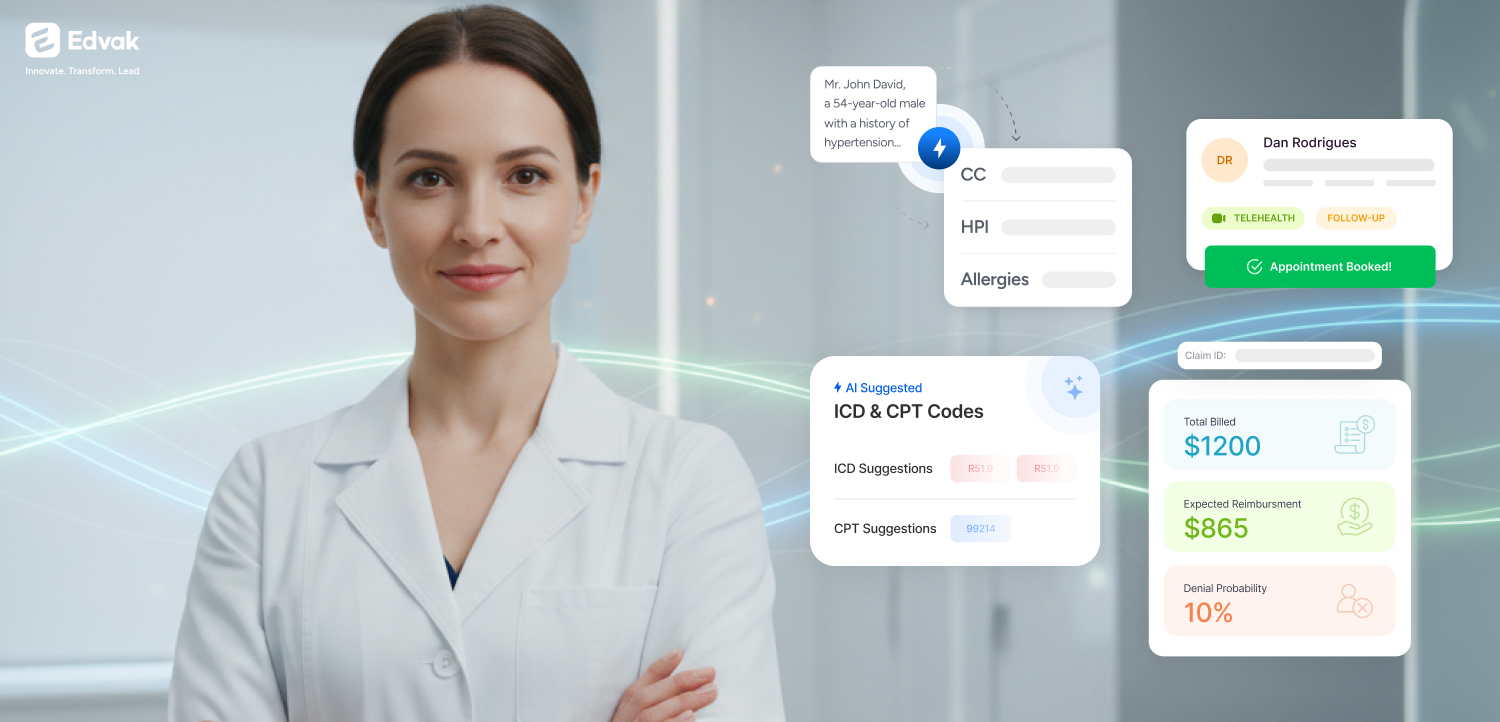
🕐 Read Time: 16 min
AI-Native EHR vs Traditional EHR: Why Add-On AI Is Not Enough
Traditional EHRs were built to digitize records. AI-native EHRs are built to connect workflows. For practices evaluating AI-native EHR vs traditional EHR software, the key question is not whether an EHR has an AI feature, but whether AI is embedded across documentation, coding, billing, scheduling, intake, patient engagement, referrals, telehealth, and analytics. Edvak is built for this connected AI-native model, helping practices move beyond bolt-on AI and fragmented workflows.
For most of the past two decades, the EHR did exactly what it was designed to do. It moved paper charts onto screens, standardized documentation, and made billing and compliance records easier to store and retrieve. That was a genuine advance. But storing a record and running a workflow are two different jobs, and many traditional systems were optimized for the first.
The gap shows up in daily operations. A provider finishes a note, then a coder works the chart separately, then a biller checks eligibility in another system, then the front desk sends reminders through a different tool, then leadership pulls a static report a week later. Each step works, but the connections between them depend on people moving information by hand. Adding an AI scribe or a coding assistant on top of that arrangement can speed up one step without changing the underlying fragmentation. That is the heart of the AI-native EHR vs traditional EHR question, and it is what this article examines.
For a broader category overview, see Edvak’s guide to the best AI-native EHR. This article focuses specifically on how AI-native EHRs differ from traditional EHR systems.
What Is a Traditional EHR?
A traditional EHR is the kind of system most practices already know. It digitized patient records and brought charting, scheduling, billing, prescriptions, labs, and compliance documentation into one electronic place. For the problem it was designed to solve, replacing paper and disconnected filing, it worked well.
The defining characteristic is that many traditional EHRs were built primarily as record-centered systems. They are excellent at holding information, but the workflows around that information often still depend on templates, manual documentation, manual coding steps, and separate operational tools. A practice may run scheduling in the EHR, intake on paper or a separate portal, patient texting through a standalone service, and analytics through exported spreadsheets.
A traditional EHR is usually record-centered: it stores clinical and administrative information, but many workflows still depend on manual steps, external tools, and staff coordination.
None of this makes traditional EHRs bad software. They can be reliable, well-supported, and deeply familiar to staff. The point is narrower and more useful for a buyer to understand: they were not originally designed around AI-native workflow automation, because that capability did not exist when most of them were architected. Judging them against that standard is less about criticism and more about recognizing what a different design can now do.
What Is an AI-Native EHR?
An AI-native EHR is an electronic health record platform designed with AI as a core workflow layer, helping connect documentation, coding, billing, scheduling, patient intake, patient engagement, referrals, document processing, telehealth, and analytics.
The word that matters is “native.” AI-native means AI is not just an added feature sitting beside the record. AI is embedded across the workflow, so the output of one step can inform the next without a person re-entering data. The goal is to reduce fragmentation and support teams across the full care journey rather than improving a single isolated task. Edvak is designed as an AI-native multi-specialty EHR built around exactly this principle.
For a broader category overview, see Edvak’s guide to the best AI-native EHR. Practices can also use the AI-native EHR maturity model and AI-native EHR operating model to evaluate how deeply AI is embedded across clinical, operational, patient engagement, and revenue cycle workflows.
AI-Native EHR vs Traditional EHR: Key Differences
The clearest way to see the contrast is side by side. The table below maps the same functional areas across both models.
| Area | Traditional EHR | Edvak AI-Native EHR |
|---|---|---|
| Core design | Record-centered | Workflow-centered |
| AI architecture | Added later or through integrations | Built into connected workflows |
| Documentation | Manual, template-heavy, or scribe-dependent | AI-assisted structured documentation |
| Coding | Manual or separate coding workflow | Connected ICD/CPT code capture support |
| Billing and claims | Often separate or workflow-dependent | Connected billing and revenue cycle workflows |
| Scheduling | Basic scheduling or separate tools | Connected scheduling workflows |
| Patient intake | Manual forms or separate intake tools | Patient intake with auto charting |
| Patient engagement | Often separate messaging or reminder tools | Connected communication and engagement workflows |
| Referrals and documents | Manual tracking or external workflows | Connected referral, document, and fax workflows |
| Telehealth | Often separate or integrated later | Connected telehealth with AI scribe support |
| Analytics | Static reports or fragmented dashboards | Real-time clinical, operational, and revenue analytics |
| Multi-specialty support | Often requires customization or workarounds | Designed for specialty flexibility |
| Workflow model | Staff coordinate around the system | System supports staff across the workflow |
The biggest difference is architecture. A traditional EHR may store the record, but an AI-native EHR like Edvak is designed to connect the work around the record.
Why Bolt-On AI Is Not Enough
Here is a pattern that plays out in many modernizing practices. They add an AI scribe to a traditional EHR to ease the documentation burden. It helps, so next they add a separate intake tool to speed up the front desk. Then a separate patient texting tool for reminders. Then a separate coding or billing tool. Then a separate analytics dashboard to make sense of it all.
Each tool may genuinely solve the one problem it was bought for. But viewed together, the overall workflow can become more fragmented, not less. Staff still have to move data between tools, reconcile information that lives in two places, check statuses across multiple logins, and manage the exceptions that fall between systems. The practice has more capability and more coordination overhead at the same time.
Bolt-on AI can make one task faster, but it does not always make the practice workflow smarter.
| Add-On Tool | What It May Help With | What It May Not Solve |
|---|---|---|
| AI scribe | Note generation | Coding, claims, scheduling, intake, engagement, analytics |
| Coding tool | Code suggestions | Documentation quality, eligibility, claims, payments |
| Intake tool | Forms and demographics | Documentation, billing, claims, engagement |
| Patient texting tool | Communication | Chart context, scheduling, billing, reporting |
| Analytics dashboard | Reporting | Workflow execution and real-time operational action |
For a deeper look at why documentation tools alone are not enough, read Edvak’s guide to AI-native EHR vs AI scribe. This article focuses on the broader issue: why adding AI tools to a traditional EHR can still leave practices with disconnected workflows.
Why Edvak Is Built Differently
Edvak is built differently because it is designed as an AI-native multi-specialty EHR, not a traditional recordkeeping system with AI added later. Edvak connects clinical, operational, patient engagement, and revenue cycle workflows in one platform, helping practices move from fragmented tools to connected workflow intelligence.
At the center of Edvak’s approach is Darwin AI, Edvak’s intelligent healthcare AI layer that supports documentation, workflow automation, coding assistance, insights, and operational intelligence across the platform. Because Darwin AI is part of the foundation rather than a plug-in, the work done at one stage carries into the next instead of stopping at a tool boundary.
Edvak’s AI-native advanced EHR software connects with practice management software, a patient engagement platform, billing and revenue cycle management software, and analytics and reporting software, giving practices one connected foundation for care delivery and operations.
Edvak's connected AI-native workflows
- Documentation covers conversation capture, structured notes, AI-powered documentation, and integrated speech-to-text.
- Coding and billing covers ICD/CPT code capture, eligibility checks, claims management, and payment workflows.
- Practice operations covers scheduling, task management, referrals, document management, fax workflows, and autofill document parsing.
- Patient engagement covers intake, two-way SMS, automated reminders, patient portal, and online scheduling.
- Clinical workflows cover decision support, e-prescribing, labs, imaging, and telehealth with AI scribe.
- Analytics covers dashboards, revenue analytics, provider productivity, patient flow, alerts, and reporting.
The value is not that any one of these exists. It is that they share a single foundation, so a note can inform a code, an intake form can populate a chart, and an engagement reminder can reflect the patient’s actual status.
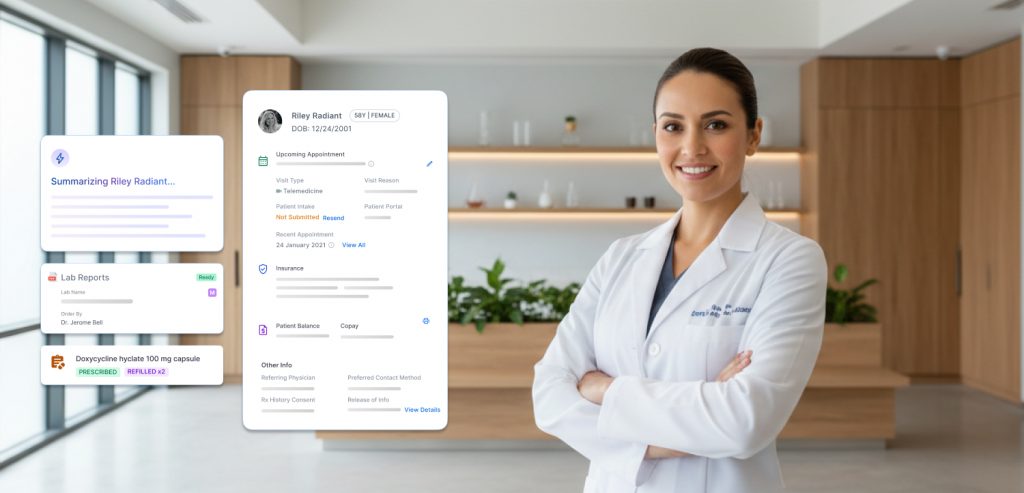
Traditional EHR with AI Features vs AI-Native EHR Architecture
It is worth separating two ideas that often get blurred in sales conversations: adding AI features and building around AI workflows. A traditional EHR with AI features may still keep its workflows separate, with AI improving individual tasks. AI-native architecture connects those workflows by design.
So the distinction is not simply “has AI” versus “does not have AI.” Almost every modern EHR can now claim some AI capability. The distinction is whether AI improves the whole workflow or only one task within it. Edvak is built around workflow connection, which is a different design choice from layering features onto a record-centered core.
The question is not, “Does the EHR have AI?” The better question is, “Where does AI live in the workflow?”
| Question | Traditional EHR with AI Features | AI-Native EHR Architecture |
|---|---|---|
| Clinical documentation | Often limited or added later | Yes |
| Does AI connect notes to coding? | May vary | Yes |
| Does AI support billing workflows? | Often separate | Yes |
| Does AI connect patient intake to charting? | May require separate tools | Yes |
| Does AI connect engagement and follow-up? | Often separate | Yes |
| Does AI support real-time operational visibility? | Often limited | Yes |
| Does AI reduce tool fragmentation? | Not always | Yes |
When Should a Practice Replace a Traditional EHR?
Replacing an EHR is a significant decision, and it is rarely triggered by the system failing at its original job. More often, it is triggered by the system not keeping up with how the practice now needs to operate. Common signals include:
- Providers still spending too much time documenting
- Staff jumping between too many disconnected tools
- Coding and billing delays
- Claim visibility issues
- Eligibility checks happening too late
- Intake forms not mapping cleanly into charts
- Patient communication happening outside the EHR
- Referrals and faxes being tracked manually
- Reports being static, delayed, or incomplete
- Multi-specialty workflows requiring too many workarounds
- Leadership lacking visibility across providers, payers, locations, and specialties
A practice may not need a new EHR because the old one stores records poorly; it may need a new EHR because the old one does not connect the work around the records.
For specialty groups and growing practices, the evaluation often goes beyond basic EHR replacement. Edvak’s guide to the best AI-native EHR for multi-specialty practices explains why specialty flexibility matters, while the best AI-native EHR platforms guide gives a broader market comparison.
Key Features to Look For in an AI-Native EHR
Use this as a practical checklist when evaluating platforms.
1. AI-assisted documentation
Look for documentation that is structured at the source rather than dictated and cleaned up later. Internal links: AI-powered documentation and conversation capture to structured notes
2. Integrated speech-to-text
Speech capture should feed directly into the chart and downstream workflows, not into a separate transcript that someone has to move. Internal link: integrated speech-to-text for healthcare
3. Coding and billing automation
Coding, eligibility, and claims should connect to documentation so the revenue cycle starts clean. Internal links: auto capture of ICD and CPT codes, real-time insurance eligibility checks, and claims management software
4. Patient intake and scheduling
Intake should populate the chart automatically, and scheduling should connect to the rest of the visit workflow. Internal links: patient intake with auto charting and online scheduling software
5. Patient engagement
Communication, reminders, and the patient portal should reflect real chart and scheduling context. Internal links: 2-way SMS chat and phone calls, automated care reminders, and patient portal software
6. Referral, document, and fax workflows
Referrals, documents, and faxes should be tracked inside the system rather than on paper or in inboxes. Internal links: referral management software, medical document management, AI fax management, and autofill document parser
7. Clinical decision support and connected care
Decision support, prescribing, labs, imaging, and telehealth should share the same record and intelligence layer. Internal links: clinical decision support, e-prescribing and medication management, electronic labs and imaging, and telehealth with AI scribe
8. Analytics and reporting
Reporting should be real-time and segmentable, not a static export. Internal link: analytics and reporting software
9. Provider control, security, and auditability
AI suggestions should be reviewable and editable, and providers and staff should stay in control. Healthcare AI should support HIPAA-aligned workflows, audit trails, role-based access, and secure handling of patient information.

Common Mistakes Practices Make When Comparing AI-Native and Traditional EHRs
Mistake 1: Assuming any EHR with AI is AI-native
Adding AI features does not automatically make an EHR AI-native. A feature improves a task; an architecture connects the workflow.
Mistake 2: Solving documentation but ignoring billing
An AI scribe can improve notes, but practices also need coding, eligibility, claims, payments, and revenue visibility. Fixing the note alone leaves most of the revenue cycle untouched.
Mistake 3: Adding too many disconnected tools
Adding separate AI tools can create new workflow and integration burdens. More tools can mean more logins, more reconciliation, and more places for work to fall through.
Mistake 4: Ignoring front-desk and administrative workflows
AI should support scheduling, intake, reminders, referrals, documents, and patient communication, not just the clinical note. Administrative friction is where much of a practice’s time actually goes.
Mistake 5: Choosing record storage over workflow intelligence
Modern practices need systems that connect work, not just store charts. A system that holds information well but does not move it well leaves productivity on the table.
Mistake 6: Forgetting multi-specialty growth
Practices adding providers, locations, or specialties need flexible workflows. A system that fits today’s single specialty can become a constraint as the practice grows.
The right EHR decision is not just about features. It is about whether the platform helps the entire practice operate better.
Trust, Security, and the Role of AI
A platform that touches documentation, coding, billing, and patient communication handles some of the most sensitive data in healthcare, so trust is foundational rather than optional. An AI-native EHR should operate within HIPAA-aligned workflows, maintain audit trails that show who reviewed and approved each decision, enforce role-based access so staff see only what their role requires, and handle patient information securely across every workflow.
It also helps to be precise about what AI does here. Across documentation, coding, claims, scheduling, and engagement, the role of AI is to assist. It surfaces suggestions, flags potential issues, and makes the workflow visible. It does not replace clinicians, coders, billers, or staff, and it does not make compliance decisions on its own. The accuracy of a note, the validity of a code, and adherence to payer and regulatory rules remain human responsibilities, supported by better tooling. Automation that strengthens the judgment of qualified people is the goal; automation that removes accountability is not.
Reviewed by Edvak’s healthcare technology team.
Why Edvak Is the AI-Native Alternative to Traditional EHRs
For practices comparing AI-native EHR vs traditional EHR software, the most important difference is workflow architecture. Traditional EHRs were built primarily to store records and support basic healthcare workflows. Edvak is built as an AI-native EHR to connect the work around the record, including documentation, coding, billing, scheduling, intake, patient engagement, referrals, telehealth, and analytics.
Bolt-on AI may improve one task, such as note generation or coding suggestions, but it does not always solve the broader workflow problem. Practices need a connected system that helps providers, front-desk teams, billers, referral coordinators, administrators, and leadership work from one platform.
Edvak is built for that category: an AI-native multi-specialty EHR designed for independent practices, specialty groups, multi-location clinics, and ambulatory care organizations that want connected workflows instead of fragmented tools.
See how Edvak’s AI-native EHR connects documentation, coding, billing, patient engagement, and analytics in one workflow.
Book a demo of Edvak’s AI-native EHR platform.
Frequently Asked Questions About AI-Native EHR vs Traditional EHR
-
What is the difference between an AI-native EHR and a traditional EHR?
A traditional EHR is usually record-centered, while an AI-native EHR is workflow-centered. Traditional EHRs store patient information and support basic workflows, while AI-native EHRs like Edvak connect documentation, coding, billing, scheduling, intake, patient engagement, referrals, and analytics.
-
Is an EHR with AI features the same as an AI-native EHR?
No. An EHR with AI features may add AI to an existing system, while an AI-native EHR is designed with AI embedded across core workflows from the start.
-
Why is bolt-on AI not enough for healthcare practices?
Bolt-on AI may improve one task, such as documentation or coding, but it can still leave practices with disconnected workflows. An AI-native EHR connects AI across the full practice workflow.
-
What is a legacy EHR with AI?
A legacy EHR with AI is an established EHR system that adds AI features into existing workflows. This can be useful, but it may not provide the same workflow connection as an AI-native EHR architecture.
-
Why is Edvak different from a traditional EHR?
Edvak is designed as an AI-native multi-specialty EHR that connects documentation, coding, billing, scheduling, patient intake, patient engagement, referrals, telehealth, documents, fax workflows, and analytics in one platform.
-
Can an AI-native EHR help reduce disconnected tools?
Yes. An AI-native EHR can help reduce the need for separate tools by connecting documentation, coding, billing, scheduling, intake, patient engagement, referrals, and reporting in one workflow.
-
Should a practice replace its traditional EHR?
A practice may consider replacing its traditional EHR if providers and staff rely on too many disconnected tools, documentation takes too long, billing workflows are delayed, patient communication is fragmented, or reporting lacks real-time visibility.
-
Is an AI scribe enough to modernize a traditional EHR?
No. An AI scribe can help with documentation, but it does not usually solve coding, billing, scheduling, intake, referrals, patient engagement, claims management, or analytics.
-
What features should an AI-native EHR include?
An AI-native EHR should include AI-assisted documentation, structured notes, coding support, eligibility checks, claims workflows, scheduling, patient intake, patient engagement, referrals, document processing, telehealth, analytics, security controls, and provider review.
-
What type of practice is Edvak best suited for?
Edvak is best suited for independent practices, specialty groups, multi-specialty clinics, multi-location practices, and ambulatory care organizations that want one connected AI-native EHR platform.
Ready to take the next step?
Get a personalized demo and see how Edvak can drive real impact to your practice.
Related Blogs




More Categories
Edvak.com Terms & Conditions Privacy Policy © 2026 Edvak. All rights reserved.