

🕐 Read Time: 16 min
Best EHR for Cardiology: The Complete Guide for US Cardiology Practices in 2026
Choosing the wrong EHR for a cardiology practice is one of the most expensive operational mistakes a cardiologist can make.
Not because the software costs too much. Because it costs too much to run the practice on a system that was never designed for cardiovascular medicine.
Every evening spent finishing charts that should have been completed during the day. Every claim denied because the billing code did not match the clinical complexity documented in the note. Every referral that fell through because the tracking system was a fax machine and a phone call. Every patient who no-showed for a stress test because the reminder system sent a generic appointment confirmation instead of caffeine restriction instructions.
None of these are small inefficiencies. Across a cardiology practice seeing 30 to 50 patients per day, they add up to hours of lost provider time every week, thousands of dollars in denied revenue every month and a patient care experience that does not reflect the quality of the clinical work being done.
The best EHR for cardiology solves all of these problems simultaneously. This guide explains what that means in practice, what specific features make a cardiology EHR genuinely the best and why Edvak is the platform that US cardiology practices are choosing in 2026.
Why Cardiology Needs the Best EHR, Not Just Any EHR
The EHR market has hundreds of platforms. Most of them work adequately for primary care. Almost none of them work well for cardiology without significant customization, workarounds and staff adaptation to fill the gaps.
Cardiology is structurally different from primary care in five specific ways that determine whether an EHR genuinely supports the practice or quietly undermines it.
Documentation Complexity
A cardiology encounter is not a 15-minute visit with a chief complaint and a prescription. A chest pain evaluation requires detailed cardiovascular history, validated risk stratification, thorough cardiovascular examination findings, EKG interpretation with specific findings documented, differential diagnosis reasoning and a treatment plan that accounts for multiple concurrent cardiac conditions. A heart failure follow-up requires symptom assessment against validated scoring systems, volume status examination, medication adjustment with reasoning documented and patient education recorded.
Documentation that does not capture this complexity accurately cannot support the billing codes that reflect the complexity of the encounter. The result is systematic undercoding of cardiology encounters that costs the practice meaningful revenue on every patient seen.
Imaging and Testing Integration
Cardiology is an imaging-driven specialty. Echocardiograms, nuclear stress tests, cardiac catheterization reports, device interrogation data from pacemakers and ICDs, Holter monitor results and CT coronary angiography reports all need to live in the patient chart, connected to the clinical documentation and accessible in one click during the encounter.
When these results sit in a PACS system that does not connect to the EHR, the cardiologist spends time hunting for results rather than interpreting them. When device interrogation data arrives on paper rather than as structured longitudinal data in the chart, the trends that inform device management decisions become invisible.
Referral Coordination
Cardiology practices sit at the center of complex referral networks. Receiving referrals from primary care. Sending patients to interventional cardiologists, electrophysiologists and cardiac surgeons. Getting results back from cath labs. Receiving hospital discharge summaries for patients who had cardiac events between appointments.
When referral management is fax-based and untracked, referral loops do not close reliably. Patients get lost between providers. Results arrive without being routed to the correct physician. Prior authorizations sit unresolved until someone notices the appointment is approaching.
Billing Complexity
Cardiology billing involves procedure codes for echocardiography, stress testing, nuclear imaging and device management that require specific documentation to support the codes billed. Evaluation and management codes need to reflect the documented complexity of the clinical decision-making. Modifier usage for bilateral procedures, multiple procedures on the same day and split-shared visits with APPs requires accurate documentation at the point of care.
When billing codes are entered manually from clinical notes that were not structured around billing requirements, systematic coding errors are predictable. Undercoded complex encounters. Missing modifiers. Unsupported procedure codes. Each represents preventable revenue loss.
Patient Safety
In cardiology, a missed follow-up is not just a revenue issue. A heart failure patient who does not attend their scheduled follow-up faces elevated hospitalization risk. A post-MI patient who misses their two-week visit may have undetected complications. The EHR that manages patient communication, reminder workflows and care gap identification is directly connected to patient outcomes in cardiology in a way that is not true for most other specialties.
What Makes an EHR the Best for Cardiology
The best EHR for cardiology is not the one with the most features. It is the one where every feature that matters for cardiovascular medicine is built natively into the system and connected to every other relevant workflow.
Here is what that looks like feature by feature.
AI-Powered Clinical Documentation
AI-Powered Documentation that captures cardiology-specific clinical notes during the visit rather than after it is the single most impactful feature in a cardiology EHR for provider satisfaction and retention.
Conversation Capture to Structured Notes listens to the cardiology consultation in real time and organizes the content into a structured clinical note automatically. The cardiologist focuses entirely on the patient. The documentation happens in the background. At the end of the consultation, the provider reviews and approves a drafted note in two to four minutes rather than writing it from memory at the end of a ten-hour day.
Integrated Speech-to-Text extends this capability into full voice navigation of the chart during the encounter. During a cardiac examination or procedure, the cardiologist navigates the chart, updates fields and places orders by voice without interrupting the clinical workflow.
Clinical Decision Support analyzes patient data during the encounter and surfaces cardiac risk alerts, drug interaction warnings for cardiac medications and MIPS quality measure prompts in real time at the moment they are clinically relevant.
For a detailed look at how Edvak‘s complete cardiology EHR capabilities work across every stage of the patient encounter, the EHR for cardiology complete guide covers every workflow from pre-visit preparation through to post-visit analytics.
Digital Patient Intake with Auto Charting
Patient Intake with Auto Charting sends cardiology-specific digital intake forms to patients automatically via SMS and email when an appointment is booked. The form captures comprehensive cardiac history including prior cardiac events, previous procedures such as catheterization and stenting, current cardiac medications, cardiac symptoms and their characteristics, relevant family history of coronary artery disease and sudden cardiac death.
When the patient submits the form before arriving, Edvak auto-charts the submitted data directly into the patient record. The cardiologist opens the chart before the encounter and finds the relevant cardiac history already populated. The consultation starts from a position of clinical context rather than from a blank chart.
E-Prescribing and Medication Management
E-Prescribing and Medication Management handles the complex medication management reality of cardiology. Cardiac patients are typically on multiple medications simultaneously. Anticoagulants, antiplatelets, beta blockers, ACE inhibitors, ARBs, diuretics, statins, antiarrhythmics and heart failure medications often run concurrently and interact with each other and with non-cardiac medications in clinically significant ways.
Electronic prescribing with comprehensive drug-drug interaction checking handles this complexity at the point of prescribing rather than after an adverse event. On-demand medication history across all prescribers is available in one click during the encounter. EPCS compliance for controlled substance prescribing meets the requirements of every US state including California’s multi-factor authentication requirements.
Scheduling for Cardiology Complexity
Scheduling in Edvak handles the specific complexity of cardiology appointment management. Appointment types are configured to reflect cardiology reality. Stress tests requiring pre-authorization verification. Device checks requiring the EP lab. Urgent chest pain evaluations requiring flexible time and priority access. Multi-provider coordination for procedures requiring both the cardiologist and a technologist simultaneously.
Online Scheduling gives stable cardiac patients the ability to book routine follow-up appointments directly through the Patient Portal at any hour, freeing front desk time for the complex scheduling decisions that require human judgment.
Automated Care Reminders send appointment reminders and procedure-specific preparation instructions automatically. A patient scheduled for a nuclear stress test receives caffeine restriction instructions, medication hold guidance and preparation details without any staff member manually composing or sending them.
2-Way SMS Chat allows patients to confirm, cancel or reschedule directly through a HIPAA-compliant channel that is logged against the patient record automatically.
Referral Management
Referral Management connects the cardiology referral workflow from initiation through result receipt within one system.
Outgoing referrals to interventional cardiologists, electrophysiologists and cardiac surgeons are initiated electronically with relevant clinical documentation attached. The receiving specialist gets a complete structured referral rather than a faxed cover sheet with incomplete information.
Incoming referral documents from primary care physicians are processed through Autofill Document Parser, which extracts patient demographics, reason for referral, current medications and relevant clinical history and populates the fields in the cardiology EHR automatically.
Real-time referral status tracking shows when referrals are accepted, when patients are scheduled and when results are received. The referral loop closes inside Edvak rather than through follow-up phone calls and fax confirmations.
For Texas cardiology practices where the complexity of coordinating referrals across hospital systems and cath labs is a daily operational challenge, the Texas cardiology practice management software guide covers exactly how Edvak handles Texas-specific referral network coordination including MIPS care coordination measure tracking.
Fax Management and Document Processing
Fax Management reads every incoming fax using AI. Hospital discharge summaries for cardiac events, imaging reports from outside facilities, prior authorization approvals, specialist consultation notes and lab results from reference laboratories are all categorized, matched to the correct patient chart and routed to the appropriate physician automatically.
Autofill Document Parser extracts structured clinical data from incoming documents. A hospital discharge summary following a cardiac event is parsed to extract diagnoses, procedures performed, medications at discharge, follow-up instructions and key laboratory values. This data populates the patient chart without manual entry.
Electronic Labs and Imaging receives lab results directly into the patient chart with AI-flagged abnormal values highlighted before the provider opens the chart. The cardiologist arrives at the chart already oriented to what needs attention rather than reviewing every value from scratch.
Auto-Capture of ICD and CPT Codes
Auto Capture of ICD and CPT Codes reads the approved clinical note and assigns the correct ICD-10 and CPT billing codes automatically without manual input from the provider or the billing team.
For cardiology specifically, this means procedure codes for echocardiography, stress testing and device management are assigned based on the documented procedure. Evaluation and management codes are assigned based on documented medical decision-making complexity. Modifier usage is applied based on the clinical context documented in the note. Missing charges are flagged before the claim is submitted. Denial prediction identifies high-risk claims before they reach the clearinghouse.
The revenue impact of this automated code capture from complete AI-documented notes is significant for cardiology practices. The combination of more complete documentation through Conversation Capture to Structured Notes and more accurate code generation from those complete notes through Auto Capture of ICD and CPT Codes reduces claim denials and improves revenue capture simultaneously.
Claims Management and Revenue Cycle
Real-Time Insurance Eligibility Checks verify patient coverage before every appointment. For cardiology practices where cardiac procedures carry high reimbursement and prior authorization requirements, knowing the insurance status and authorization status before the patient arrives prevents the revenue and clinical disruptions that eligibility-related denials create.
Claims Management tracks every claim from creation through payment with automated error detection before submission, Electronic Remittance Advice integration for automatic payment reconciliation and denial prediction analytics. For cardiology practices with complex procedure billing, this pre-submission error detection is where significant revenue protection happens every day.
Patient Payments and Statements handles patient balance collection through automated statement generation and SMS payment links sent immediately after visits. Outstanding balances do not sit waiting for a manual follow-up call that may or may not happen.
Telehealth with AI Scribe
Telehealth with AI Scribe supports virtual cardiology consultations for stable cardiac patients who do not require in-person examination. Post-procedure follow-ups for stable patients. Medication management visits for well-controlled chronic conditions. Second opinion consultations. Patient education sessions for newly diagnosed cardiac conditions.
The AI scribe listens during the telehealth session and produces a complete structured clinical note automatically. Virtual cardiology visit documentation meets the same clinical standard as in-person notes.
For California cardiology practices where telehealth adoption is high and state-specific telehealth documentation requirements apply, the best EHR for cardiologists in California guide covers how Edvak meets California telehealth documentation standards and EPCS requirements alongside CCPA compliance.
Task Management
Task Management closes the care loops that scheduling and documentation alone cannot cover. Prior authorizations are assigned and tracked before procedure appointments. Lab result review tasks route to the appropriate provider automatically. Follow-up scheduling tasks are created when clinical notes indicate a specific monitoring requirement. For MIPS quality measure reporting, task management captures the process measures that contribute to the composite score, beta blocker prescription post-MI, statin therapy optimization and blood pressure control documentation, without requiring separate manual tracking.
Patient Portal
Patient Portal gives cardiac patients 24/7 access to their clinical records, lab results, echocardiogram reports, medication lists, upcoming appointments and billing statements. For patients managing chronic cardiac conditions between appointments, this access supports better self-management and reduces the volume of phone calls to the practice for routine information requests.
Direct messaging with the care team through the portal gives cardiac patients a HIPAA-compliant channel for questions about symptoms, medication changes and follow-up needs. Prescription refill requests through the portal reduce phone volume for stable cardiac patients on established medication regimens.
Analytics and Reporting
Analytics and Reporting powered by AI answers plain-language voice or text queries with dynamic charts and reports generated in seconds. Cardiology practice owners ask about revenue by procedure type, no-show rates by appointment type and provider, claim denial rates by payer and procedure code and MIPS quality measure performance. For multi-location cardiology groups, centralized analytics compare performance across every site from one dashboard without manual data exports or reconciliation.
WHAT IS THE BEST EHR FOR CARDIOLOGY? -
The best EHR for cardiology is a specialty-specific electronic health record system where every clinical and administrative workflow relevant to cardiovascular medicine runs natively in one connected platform. It includes cardiology-specific AI clinical documentation that captures complex cardiac encounter notes in real time, digital patient intake with cardiovascular history fields, electronic prescribing with comprehensive cardiac drug interaction checking, referral management for cardiology specialist networks, AI-powered fax and document processing for incoming cardiac imaging and hospital records, cardiology-specific billing code auto-capture with MIPS quality measure tracking, claims management with denial prediction and patient engagement tools that address the patient safety implications of no-shows in cardiac care.
Inside Edvak, the best EHR for cardiology includes Electronic Health Records, E-Prescribing and Medication Management, Electronic Labs and Imaging, Integrated Speech-to-Text, Conversation Capture to Structured Notes, AI-Powered Documentation, Telehealth with AI Scribe, Clinical Decision Support, Patient Intake with Auto Charting, Scheduling, Task Management, Referral Management, Document Management, Fax Management, Autofill Document Parser, Automated Care Reminders, 2-Way SMS Chat, Patient Portal, Online Scheduling, Auto Capture of ICD and CPT Codes, Real-Time Insurance Eligibility Checks, Claims Management, Patient Payments and Statements and Analytics and Reporting, all connected to the same patient record in one AI-native platform with ONC, Drummond and Surescripts certifications.
How Edvak Compares to Other Cardiology EHR Options Comparison Table
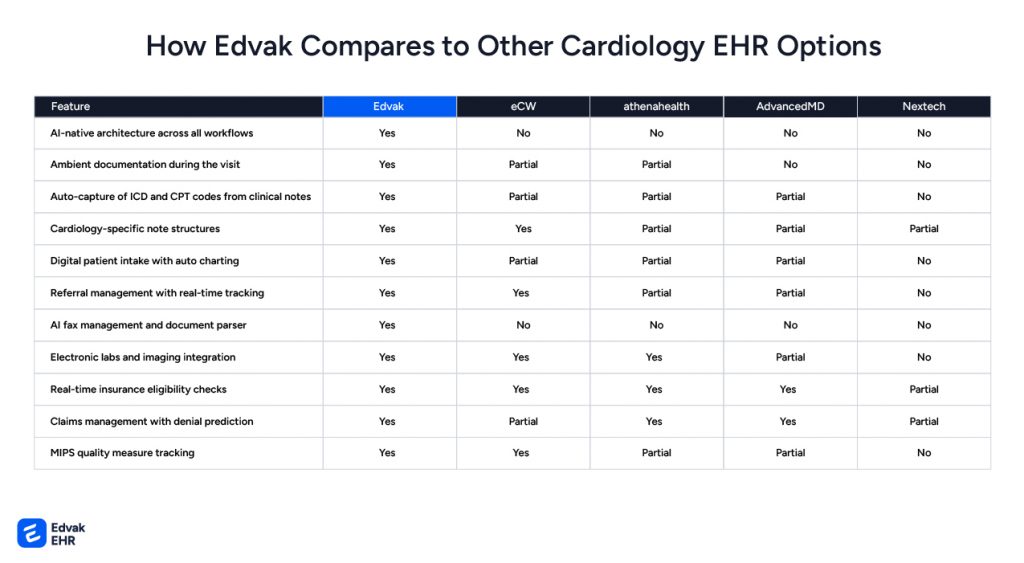
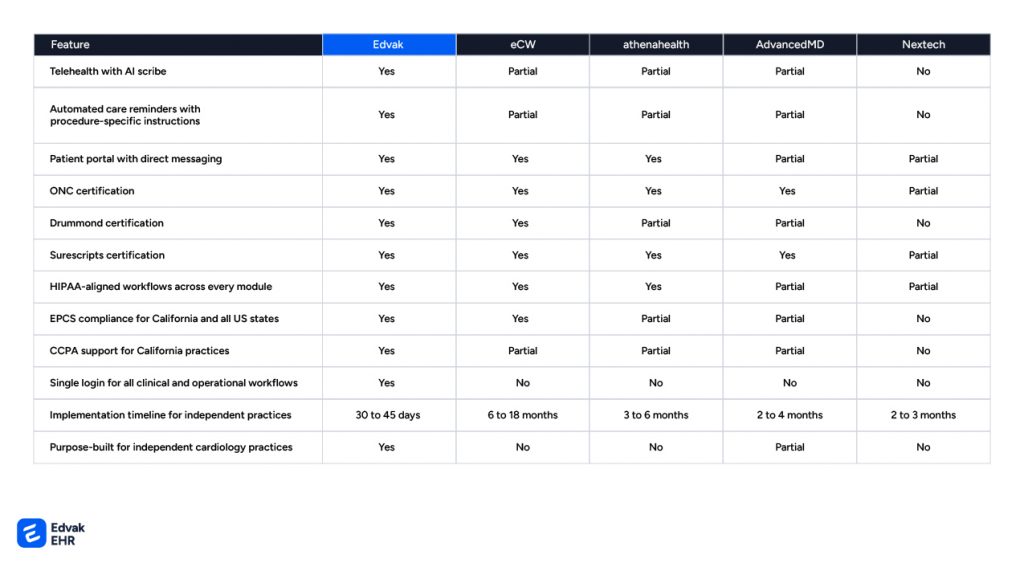
The cardiology EHR market has several established platforms. Epic is used by large hospital-affiliated practices. athenahealth is widely adopted across multi-specialty groups. AdvancedMD serves independent practices. Understanding what distinguishes Edvak from these options helps cardiology practices make a clear evaluation.
Edvak
Edvak‘s differentiator is AI-native architecture built specifically for US specialty practice workflows with cardiology as a core supported specialty. Conversation Capture to Structured Notes and AI-Powered Documentation are not features added to a general-purpose EHR. They are the foundation of how clinical documentation works across the entire platform. Auto Capture of ICD and CPT Codes generates cardiology-specific billing codes from complete AI-documented notes rather than from manually entered clinical content. Referral Management= and Autofill Document Parser handle cardiology network coordination and incoming document processing natively without separate tools.
For independent cardiology practices, solo and small group cardiologists and multi-location cardiology groups that want a platform built around how cardiology operates rather than adapted to it, Edvak is the best choice.
eClinical Works
eCW is one of the leading EHR in US hospitals. For a hospital-affiliated cardiology practice that is required to use the system their hospital has already implemented, eCW is not a choice. It is an infrastructure decision made above the practice level.
For independent cardiology practices evaluating their own EHR, eCW is designed for enterprise hospital operations, not for independent specialty practices. The implementation cost is significant, the configuration overhead is substantial and the ongoing IT requirements are beyond what most independent cardiology practices can manage efficiently.
Athenahealth
athenahealth is a strong platform for multi-specialty ambulatory care with well-developed revenue cycle management. For cardiology, the limitation is that it is not specialty-specific. Cardiology-specific documentation templates, cardiac imaging integration and cardiology-specific billing code logic all require customization that adds cost and implementation time.
AdvancedMD
Most EHRs on the market were AdvancedMD serves independent practices effectively with strong billing automation. For cardiology, the documentation capabilities are general-purpose and the cardiology-specific clinical workflow support requires significant template development during implementation.
Nextech
Nextech is widely used in specialty practices such as dermatology, ophthalmology and plastic surgery, where its workflows are more mature and closely aligned with those specialties.
For cardiology, the limitation is that the system is not built around cardiovascular workflows. Cardiology-specific documentation, imaging integration for echo and stress testing, and device data management are not native to the platform. These capabilities require customization or external integrations, which adds complexity and reduces workflow efficiency during patient encounters.
For cardiology practices evaluating an EHR, Nextech functions as a general specialty platform rather than a cardiology-focused system. The result is a workflow that often needs to be adapted by the practice instead of being supported by the system out of the box
WHY EDVAK IS THE BEST EHR FOR CARDIOLOGY IN THE US
Edvak is the best EHR for cardiology in the US because it is the only AI-native platform where every clinical and operational workflow relevant to cardiovascular medicine runs natively in one connected system.
Conversation Capture to Structured Notes and AI-Powered Documentation eliminate after-hours charting. Clinical Decision Support surfaces cardiac risk alerts and MIPS quality measure prompts in real time during encounters. Patient Intake with Auto Charting populates the chart with detailed cardiac history before the provider enters the room. E-Prescribing and Medication Management handles complex cardiac polypharmacy with comprehensive drug interaction checking and EPCS compliance. Referral Management connects the cardiology specialist network from initiation through result receipt. Fax Management and Autofill Document Parser process incoming cardiac documents without staff involvement. Auto Capture of ICD and CPT Codes generates cardiology-specific billing codes from approved clinical notes automatically with denial prediction. Real-Time Insurance Eligibility Checks and Claims Management protect revenue at every step. Automated Care Reminders and 2-Way SMS Chat reduce no-shows for cardiac procedures. Telehealth with AI Scribe supports virtual cardiology consultations with the same documentation quality as in-person visits. Task Management tracks MIPS quality measures automatically. Analytics and Reporting surfaces real-time practice performance from plain-language queries.
Every capability runs inside one platform. ONC certification, Drummond certification and Surescripts certification confirm full US compliance. HIPAA-aligned workflows protect cardiac patient data across every module. State-specific compliance for Texas TMB requirements, California CCPA and EPCS standards and every other US state where cardiology practices operate is supported natively.
For US cardiology practices that want a platform built around how cardiovascular medicine actually operates rather than one that forces cardiology into a general-purpose framework, Edvak is the clear answer.
The Best EHR for Cardiology by Practice Type
The best EHR for cardiology is not the same for every practice structure. Understanding which features matter most for specific practice types helps cardiology owners evaluate the right fit.
Solo and Small Group Cardiology Practices
For a one to three cardiologist practice, provider time is the scarcest resource and every hour of administrative burden is felt directly by the clinical team.
AI-Powered Documentation and Conversation Capture to Structured Notes recover the two to three hours of after-hours charting time that solo and small group cardiologists spend every evening. Patient Intake with Auto Charting reduces front desk workload without adding staff. Automated Care Reminders reduce no-shows for cardiac procedures without manual outreach. Auto Capture of ICD and CPT Codes eliminates manual billing code entry and the coding errors that produce denials.
The entire clinical and operational workflow connects in one system so a small cardiology team operates at the efficiency of a much larger practice without the administrative overhead that larger systems require.
Multi-Location Cardiology Groups
For cardiology groups operating across multiple locations, the challenge is maintaining consistent clinical and operational standards across every site while giving the practice owner centralized visibility into performance.
Analytics and Reporting powered by AI provides centralized performance visibility across all locations from one dashboard without manual data exports or reconciliation from each site. Role-based access controls apply consistently across every location. Scheduling supports multi-location operations with providers seeing their complete schedule across all sites simultaneously.
Hospital-Affiliated Cardiology Practices
For cardiologists who split time between an office practice and hospital-based procedures, Edvak handles the inbound flow of hospital discharge summaries, catheterization reports and consultation notes through Fax Management and Autofill Document Parser. Clinically relevant data from these documents populates the office EHR without manual entry. Electronic Labs and Imaging receives outside imaging results directly into the patient chart.
Texas Cardiology Practices
Texas cardiology practices face specific compliance requirements from the Texas Medical Board alongside federal HIPAA standards. TMB telehealth documentation requirements, MIPS quality measure reporting for the CMS quality payment program and HIPAA requirements for cardiac imaging storage all apply simultaneously.
Edvak‘s task management infrastructure captures the process measures that MIPS requires. Telehealth with AI Scribe meets TMB documentation standards for virtual cardiology consultations. Role-based access controls and immutable audit trails support TMB record-keeping requirements. For a complete breakdown of how Edvak handles the full Texas cardiology compliance environment, the Texas cardiology practice management software guide covers every dimension of the Texas regulatory landscape for cardiology practices.
California Cardiology Practices
California cardiology practices face CCPA requirements alongside federal HIPAA compliance. E-Prescribing and Medication Management meets California’s EPCS multi-factor authentication requirements for controlled substance prescribing. The Patient Portal supports CCPA patient data access rights. Role-based access controls and complete audit trails meet California Medical Board documentation and record retention standards.
For solo and small group cardiology practices in California specifically, the best EHR for cardiologists in California guide covers how Edvak handles California-specific compliance requirements alongside the clinical and operational needs of small cardiology teams across Los Angeles, the Bay Area, Orange County, San Diego and the Central Valley.
HIPAA Compliance and US Certifications for the Best Cardiology EHR
Compliance is not a feature to evaluate alongside scheduling and billing. It is the baseline that determines whether a cardiology EHR can legally and safely handle patient data in the US healthcare environment.
Edvak holds ONC certification under the 21st Century Cures Act, Drummond certification through independent third-party verification and Surescripts certification for electronic prescribing network compliance. Every module operates under HIPAA-aligned workflows. Cardiac imaging, device interrogation data, echocardiogram reports and all other sensitive cardiology patient data are encrypted at rest using AES-256 and in transit using SSL. Role-based access controls limit data access to authorized personnel only. Immutable audit trails log every record access with a timestamp and user ID. Edvak signs a Business Associate Agreement with every US cardiology practice it works with.
For multi-location cardiology groups where consistent compliance across every site is a governance requirement, Edvak‘s centralized compliance architecture applies the same security controls and audit logging to every location simultaneously without requiring site-specific configuration.
THE BEST EHR FOR CARDIOLOGY CHECKLIST
Before choosing an EHR for your US cardiology practice, confirm the following:
- AI captures cardiology-specific clinical notes during the visit through Conversation Capture to Structured Notes and AI-Powered Documentation rather than requiring providers to type or dictate after the visit
- Cardiology-specific billing codes are generated automatically from approved clinical notes through Auto Capture of ICD and CPT Codes with modifier logic and denial prediction built in
- Patient intake captures comprehensive cardiac history automatically through Patient Intake with Auto Charting and populates the chart before the provider enters the room
- Referral initiation, tracking and result receipt all happen inside the same system through Referral Management without separate fax tracking
- Incoming hospital discharge summaries, imaging reports and consultation notes are processed and filed automatically through Fax Management and Autofill Document Parser
- Insurance eligibility is verified before every appointment through Real-Time Insurance Eligibility Checks rather than discovered after a claim denial
- Cardiac drug interactions are checked comprehensively at the point of prescribing through E-Prescribing and Medication Management with EPCS compliance for every US state
- Appointment reminders include procedure-specific preparation instructions through Automated Care Reminders rather than generic confirmation messages
- Telehealth documentation meets state-specific requirements through Telehealth with AI Scribe with the same clinical quality as in-person notes
- MIPS quality measure performance is tracked automatically through Task Management and Analytics and Reporting without manual compilation from multiple sources
- ONC certification, Drummond certification and Surescripts certification confirm independent verification of federal compliance standards
- A Business Associate Agreement is signed covering every module including AI documentation, fax processing and patient communication
Edvak meets every item on this checklist natively. No third-party integrations required. No workarounds. One AI-native platform built for the full complexity of US cardiology practice management.
Frequently Asked Questions About the Best EHR for Cardiology
-
What is the best EHR for cardiology in the US in 2026?
Edvak is the best EHR for cardiology in the US in 2026 because it is the only AI-native platform where every cardiology clinical and operational workflow runs natively in one connected system. AI-Powered Documentation and Conversation Capture to Structured Notes eliminate after-hours charting. Auto Capture of ICD and CPT Codes generates cardiology-specific billing codes automatically. Referral Management handles cardiology network coordination without manual fax tracking. Clinical Decision Support surfaces cardiac risk alerts in real time during encounters. Every module operates under ONC-certified, HIPAA-aligned workflows with Drummond and Surescripts certifications confirming independent compliance verification.
-
What features does the best cardiology EHR need to have?
The best cardiology EHR needs AI-assisted ambient documentation for complex cardiology encounter notes, cardiology-specific billing code auto-capture with modifier logic, digital patient intake with cardiac history fields, electronic prescribing with cardiac drug interaction checking and EPCS compliance, referral management for cardiology specialist networks, AI-powered fax and document processing for incoming cardiac imaging and hospital records, real-time insurance eligibility verification, claims management with denial prediction, automated patient communication with procedure-specific preparation instructions, telehealth with AI documentation, MIPS quality measure tracking and practice analytics. Edvak includes all of these natively in one connected platform.
-
How does an EHR improve clinical documentation for cardiologists?
The best cardiology EHR improves clinical documentation through ambient documentation capabilities that capture consultation content during the visit rather than requiring providers to write notes from memory afterward. Inside Edvak, Conversation Capture to Structured Notes listens to the cardiology consultation in real time and produces a structured clinical note automatically. The cardiologist reviews and approves in two to four minutes. This replaces the two to three hour end-of-day charting session that most cardiologists currently spend on documentation with a brief review workflow that is completed during the natural pauses between patients.
-
How does the best cardiology EHR handle billing code accuracy?
Auto Capture of ICD and CPT Codes generates billing codes from the approved clinical note automatically. For cardiology, this means procedure codes for echocardiography, stress testing and device management are assigned based on documented procedures. Evaluation and management codes reflect documented medical decision-making complexity. Modifier logic is applied based on clinical context. Missing charges are flagged before submission. Denial prediction identifies high-risk claims before they reach the clearinghouse. The accuracy of code generation depends directly on the completeness of the clinical note, which is why AI-Powered Documentation and Auto Capture of ICD and CPT Codes work together as a connected revenue protection system.
-
What is the best EHR for small cardiology practices?
For solo and small group cardiology practices, Edvak is the best EHR because it delivers the full clinical and operational capability of a large cardiology system without the implementation cost, IT overhead and administrative complexity of enterprise platforms. AI-Powered Documentation recovers the after-hours charting time that small cardiology teams cannot afford to lose. Patient Intake with Auto Charting reduces front desk workload. Auto Capture of ICD and CPT Codes eliminates manual billing code entry. Automated Care Reminders reduce no-shows without manual outreach. The entire system is designed to let a small cardiology team operate at the efficiency of a much larger practice from the first day of go-live.
-
What is the best EHR for cardiology practices in Texas?
Edvak is the best EHR for cardiology practices in Texas because it meets Texas Medical Board telehealth documentation requirements, supports MIPS quality measure reporting through integrated task management and provides the referral coordination capabilities that Texas cardiology networks require across hospital systems and cath labs. For the complete picture of how Edvak handles Texas-specific cardiology compliance and practice management requirements, the Texas cardiology practice management software guide covers every dimension of the Texas cardiology regulatory and operational environment.
-
What is the best EHR for cardiology practices in California?
Edvak is the best EHR for cardiology practices in California because it meets California CCPA patient data access requirements, California EPCS multi-factor authentication requirements for controlled substance prescribing and California Medical Board documentation and record retention standards alongside federal HIPAA compliance. For solo and small group cardiology practices across Los Angeles, the Bay Area, Orange County and San Diego, the best EHR for cardiologists in California guide covers the state-specific requirements and how Edvak handles them natively.
-
How does the best cardiology EHR handle MIPS reporting?
Task Management in Edvak captures the cardiology-relevant MIPS process measures automatically from clinical documentation and billing data. Beta blocker prescription rates post-MI, statin therapy optimization for coronary artery disease, blood pressure control documentation and care coordination measures are all tracked from the structured data that every patient encounter generates inside the platform. Analytics and Reporting surfaces MIPS quality measure performance in real time from plain-language queries without requiring manual data compilation from multiple sources. For Texas cardiology practices where MIPS reporting directly affects Medicare reimbursement rates, this automated quality measure tracking is a core operational requirement.
-
How does Edvak handle referral management for cardiology practices?
Referral Management in Edvak handles cardiology referrals from initiation through result receipt within one system. Outgoing referrals to interventional cardiologists, electrophysiologists and cardiac surgeons are initiated electronically with clinical documentation attached. Incoming referral documents are processed through Autofill Document Parser which extracts patient demographics, reason for referral and relevant clinical history automatically. Real-time status tracking shows when referrals are accepted, scheduled and completed. The referral loop closes inside Edvak without follow-up phone calls and fax confirmations. For Texas cardiology practices managing complex referral networks across hospital systems, the Texas cardiology practice management software guide covers how this works in the Texas market specifically.
-
Is Edvak HIPAA compliant for cardiology practice data?
Yes. Edvak operates under HIPAA-aligned workflows across every cardiology module. Cardiac imaging, device data, echocardiogram reports and all sensitive cardiology patient data are encrypted at rest using AES-256 and in transit using SSL. Role-based access controls limit data access to authorized personnel. Immutable audit trails log every record access with timestamp and user ID. Edvak holds ONC certification, Drummond certification and Surescripts certification and signs a Business Associate Agreement with every US cardiology practice it works with.
-
How long does it take to implement Edvak at a cardiology practice?
Most US cardiology practices complete the full Edvak implementation in 30 to 60 days. The first phase covers system configuration, cardiology-specific template setup and data migration. The second phase covers role-specific staff training. Providers learn AI documentation and clinical decision support. Front desk staff learn scheduling and patient communication. Billing staff learn the revenue cycle management workflow. Go-live follows with dedicated onboarding support. Multi-location cardiology groups may require additional time for site-specific configuration but the core system and workflow standards are consistent across all locations from day one.
-
Ready to see why Edvak is the best EHR for your cardiology practice?
Edvak is the only AI-native EHR platform built to handle the full clinical and operational complexity of US cardiology in one connected system. Electronic Health Records, AI-Powered Documentation, E-Prescribing and Medication Management, Referral Management, Fax Management, Auto Capture of ICD and CPT Codes, Claims Management, Automated Care Reminders, 2-Way SMS Chat, Telehealth with AI Scribe, Task Management and Analytics and Reporting all run natively inside Edvak from the moment a patient books an appointment to the moment their balance is collected.
Ready to take the next step?
Get a personalized demo and see how Edvak can drive real impact to your practice.
Related Blogs




More Categories
Edvak.com Terms & Conditions Privacy Policy © 2026 Edvak. All rights reserved.