
🕐 Read Time: 10 min
The AI Scribe That Actually Closes Charts: Why Texas Clinicians Choose Edvak in 2026
The difference between recording a visit and finishing a chart is everything. An AI scribe should not hand you a transcript at the end of the day. It should hand you a signable SOAP note in minutes. For Texas solo practices and specialty clinics facing documentation overload in 2026, that distinction determines whether you leave work on time or carry charts home every night.
Edvak built its AI scribe platform around one objective: help Texas clinicians sign notes faster without sacrificing quality or control. The Darwin AI system listens to your natural patient conversations, structures information into proper clinical documentation and gives you an edit-ready note before the patient leaves. This guide explains why Texas practices are choosing Edvak and how to evaluate whether it fits your specific workflow.
Why Texas Clinics Need More Than Audio Capture in 2026
Recording technology is abundant and cheap. Every smartphone can capture clear audio. The challenge facing Texas practices is not capturing words but transforming clinical conversations into documentation that meets billing requirements, supports quality measures and survives audit scrutiny.
The Documentation Gap Texas Practices Face Daily
A family medicine physician in San Antonio sees 28 patients during clinic hours. With traditional documentation, each visit generates 8 to 12 minutes of after-hours charting work. That totals 3.5 to 5.5 hours of evening documentation that cuts into dinner, family time and sleep.
Basic transcription AI scribes reduce typing but introduce new problems. The clinician receives lengthy paragraphs mixing relevant clinical details with conversational filler. Extracting the chief complaint, organizing exam findings and structuring an assessment still requires manual work that consumes 5 to 7 minutes per note.
Multiply those minutes across 140 weekly patients and the practice loses 12 to 16 hours weekly to reformatting AI-generated text. That is not time savings. That is shifting documentation burden from typing to editing.
What Changed Between Early AI Scribes and 2026 Solutions
First-generation medical AI scribes treated clinical conversations like business meetings. They transcribed everything and left organization to the clinician. Modern systems like Edvak’s Darwin AI understand medical context, clinical reasoning patterns and documentation structure requirements.
Darwin AI distinguishes between patient history and physician questions. It recognizes when exam findings merit inclusion versus when conversational acknowledgments should be excluded. It understands that a treatment plan requires specifics: medication names, dosages, frequency, duration and follow-up timing.
This clinical intelligence transforms raw conversation into structured notes that read like professional medical documentation, not transcripts with section headers added.
How Edvak's Conversation to Notes Technology Works in Texas Practices
Conversation to Notes is Edvak’s core documentation engine. It captures clinical speech, applies medical language processing and auto-structures information into SOAP format without requiring dictation or structured interviews.
Real-Time Capture Without Workflow Disruption
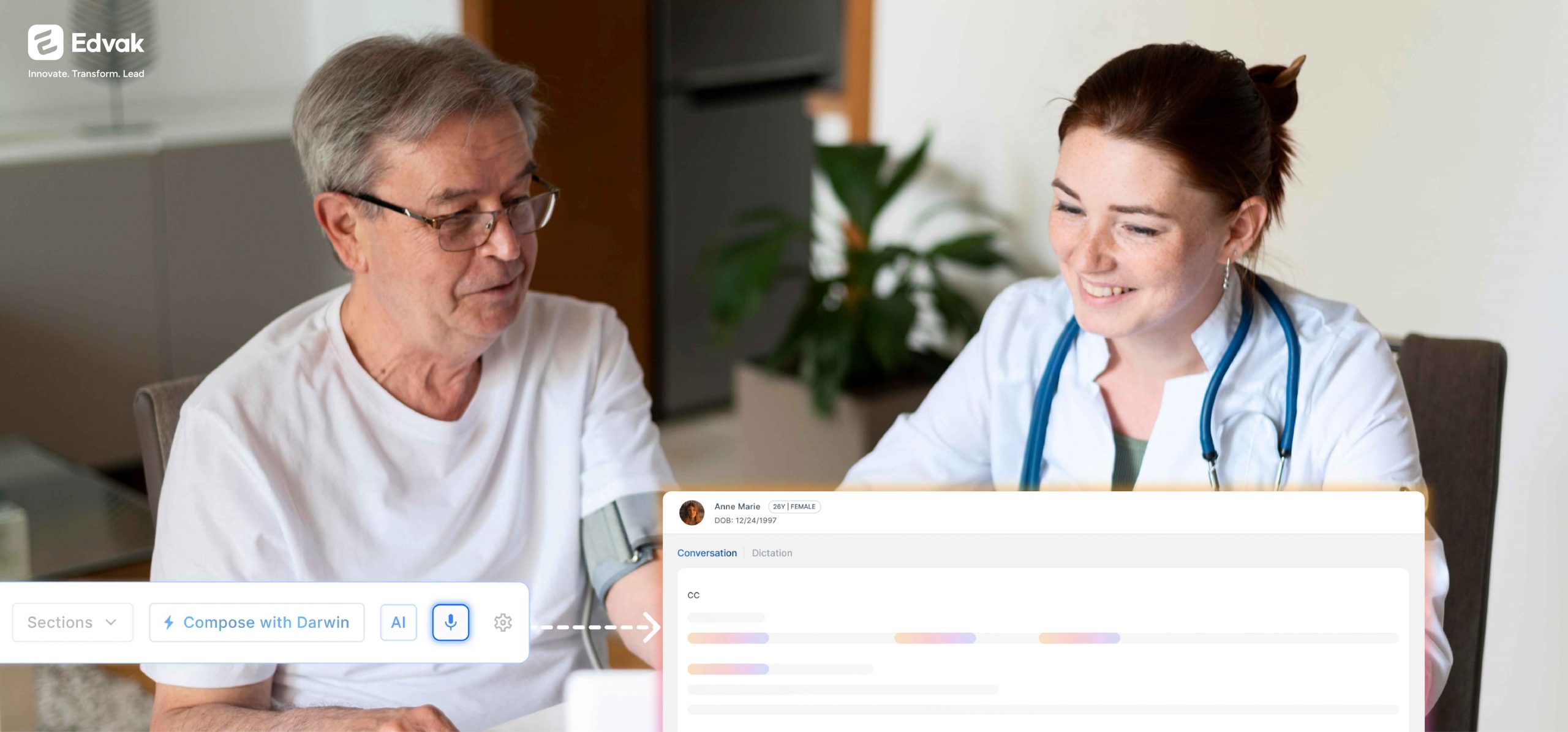
During the patient encounter, Darwin AI runs in the background. You talk naturally about symptoms, review systems, discuss findings and explain treatment options exactly as you would without technology present. The patient receives your full attention because you are not typing, clicking templates or mentally cataloging what to document later.
The system captures both sides of the conversation but applies clinical context to determine what belongs in the medical record. When a patient mentions their grandson’s baseball game, Darwin AI recognizes this as rapport-building conversation that does not require documentation. When the same patient describes chest discomfort, the system captures onset, character, duration, radiation and associated symptoms automatically.
Auto-Structured SOAP Notes That Read Correctly
Within seconds of the visit ending, Edvak generates a structured SOAP note. The Subjective section contains the chief complaint and history of present illness in narrative format, not question-and-answer transcription. The Objective section lists vitals, exam findings and relevant test results without repeating subjective information.
The Assessment synthesizes your clinical thinking into diagnostic impressions. The Plan specifies treatments with actionable detail: e-prescriptions include drug names and dosing, referrals include specialty and timing, follow-up appointments specify duration and reason.
For a Dallas internal medicine practice treating diabetic patients, this means the Plan section automatically includes A1C targets, medication adjustments with rationale, dietary counseling documentation and specific return visit intervals. The clinician reviews for accuracy and signs. No rebuilding required.
Edit-in-Place Interface Built for Speed
Edvak’s review interface eliminates the friction that kills AI scribe adoption. Click any text element to edit directly. Type your correction and move forward. No navigation menus, no separate editing modes and no copying between applications.
The system highlights elements that commonly require review: vitals needing confirmation, medications requiring dosage specification and plans missing follow-up timing. This visual guidance accelerates review for clinicians who see 30 patients daily and cannot afford to scrutinize every word of every note.
Keyboard shortcuts enable experienced users to navigate sections, accept suggestions and finalize notes in under 90 seconds for straightforward encounters. For a Houston pediatric clinic managing well-child visits, this means documentation completes between patients rather than accumulating for evening cleanup.
Facesheet Suggestions That Eliminate Redundant Entry
Texas practices maintain detailed patient facesheets in their Edvak EHR system. Edvak connects to this existing data and surfaces relevant information during documentation. Current medications, active problems and recent electronic labs and imaging appear as contextual suggestions that click into the note with one action.
When documenting a hypertension follow-up, the system recognizes this is a chronic condition management visit. It suggests pulling forward the current antihypertensive regimen, recent blood pressure readings and last medication adjustment date. The clinician confirms accuracy and includes the information without retyping.
This facesheet integration saves 2 to 3 minutes per encounter for established patients and ensures consistency between the current note and the historical record.
How AI Scribe Technology Reduces Clinical Documentation Time?
An AI scribe converts clinical conversations into structured medical documentation automatically. Edvak’s Darwin AI delivers structured SOAP notes from natural patient conversations in Texas practices, integrates directly with EHR systems and reduces after-hours charting by 70 percent through Conversation to Notes technology that captures speech, auto-structures documentation and enables edit-in-place workflows with HIPAA-aligned security.
Telehealth with AI Scribe: Why Darwin AI Handles Virtual Visits Differently
Texas telehealth volume doubled during 2020 and has maintained 85 percent of that increase through 2026. Virtual care is permanent infrastructure, not temporary adaptation. That makes telehealth documentation capability essential rather than optional in AI scribe evaluation.
The Virtual Visit Documentation Challenge
Telehealth creates compressed timelines. An in-person clinic builds in transition time: walking between rooms, greeting the next patient, reviewing their chart. Virtual clinics eliminate these natural pauses. The next video call starts immediately after the previous one ends.
Without documentation support, this rapid pace creates backlog. By the third hour of virtual clinic, a physician has 15 undocumented visits requiring chart completion. By day’s end, 40 to 50 virtual encounters wait for documentation that takes 4 to 6 hours to complete after clinic.
Edvak’s Telehealth with AI scribe technology maintains real-time documentation pace that matches virtual visit flow.
Darwin AI Audio Processing for Variable Internet Quality
Virtual visit audio quality varies significantly. Patients call from cars, home offices, construction sites and rural areas with limited bandwidth. Background noise from children, pets and household activities complicates transcription accuracy.
Darwin AI employs advanced audio filtering that isolates clinical conversation from background interference. When internet bandwidth drops and audio quality degrades, the system maintains transcription accuracy through predictive language modeling that understands medical terminology and clinical context.
For a West Texas telehealth practice serving rural communities where internet reliability varies, this audio processing capability determines whether AI scribe technology works at all.
Structured Notes Ready Within Seconds of Call End
Speed separates functional telehealth AI scribes from theoretical solutions. Edvak generates structured SOAP notes while the call is active, so documentation is review-ready the moment the video ends.
A Rio Grande Valley federally qualified health center running 200 daily telehealth visits uses this capability to maintain zero documentation backlog. Clinicians review and sign notes during the 30-second transition between video calls. They leave at the scheduled end time without carrying charts home.
This operational efficiency directly impacts practice economics. The same clinical FTE handles higher patient volume without overtime costs or burnout-driven turnover.
Privacy-First Design and HIPAA-Aligned Architecture for Texas Compliance
Healthcare AI applications handle sensitive patient information that requires rigorous security controls. Edvak built Darwin AI with privacy and compliance as foundational design principles, not features added later.
Encryption Standards and Data Handling
All clinical conversations captured by Darwin AI encrypt at the point of capture using AES-256 encryption. Data remains encrypted during transmission to processing servers and during storage. Encryption keys are managed separately from data, so unauthorized access to storage systems cannot expose patient information.
Processing occurs on HIPAA-compliant servers located in US data centers with SOC 2 Type II certification. No patient data routes through overseas servers or third-party transcription services that create compliance gaps.
Access Controls and Audit Trails
Texas medical practices need granular control over who accesses patient records within AI scribe systems. Edvak implements role-based permissions that restrict access based on job function. Front desk staff cannot access clinical notes. Medical assistants see documentation relevant to their workflow. Only licensed clinicians access complete patient records.
Every user action generates audit log entries: who accessed which patient file, when documentation was created or edited and what changes occurred. These logs support HIPAA compliance investigations and medical board inquiries that increasingly request detailed documentation access histories.
Provider Control Over Final Documentation
Darwin AI operates as an assistant, not an autonomous decision-maker. Every note requires explicit clinician review and approval before becoming part of the permanent medical record. Suggestions appear with visual indicators showing they are AI-generated content requiring verification.
Clinicians can accept, modify or reject any suggested content. The system learns from these corrections to improve future suggestions but never overrides physician judgment. This control structure ensures the attending clinician remains legally and professionally responsible for documentation accuracy.
Texas Specialty Clinic Applications: How Darwin AI Adapts to Different Practices
Medical specialties have distinct documentation requirements. A cardiology note differs substantially from a dermatology note in structure, terminology and detail level. Effective AI scribe technology must adapt to these variations without requiring extensive customization.
Family Medicine and Internal Medicine in Texas
Primary care practices juggle acute visits, chronic disease management, preventive care and behavioral health. Darwin AI recognizes visit types and applies appropriate documentation templates.
For an Austin family medicine group managing a patient panel with high diabetes prevalence, the system understands chronic disease documentation patterns. When documenting a diabetic patient visit, it prompts for A1C results, foot exam findings, retinal screening status and medication adherence assessment. The generated note includes these quality measure elements automatically.
Urgent Care and Walk-In Clinics
Texas urgent care centers operate on volume-based economics. A typical location sees 60 to 80 patients daily with minimal scheduled appointments. Documentation must be fast, accurate and adequate to support higher-acuity billing codes.
Darwin AI generates urgent care notes that capture presenting complaint, pertinent exam findings and medical decision-making rationale in the concise format these facilities require. For a DFW urgent care network, this documentation speed enabled 12 percent patient volume increase without adding clinical staff.
Specialty Practices: Cardiology and Orthopedics Examples
Specialty documentation includes procedure notes, diagnostic interpretations and complex treatment plans that general AI scribes struggle to capture accurately.
For a Houston cardiology practice, Darwin AI documents stress test interpretations, echocardiogram findings and interventional procedure notes using specialty-specific terminology. The system understands that a cardiology assessment requires ejection fraction, valve function description and rhythm analysis in standard format.
An El Paso orthopedic surgery group uses Darwin AI to document joint examinations with range-of-motion measurements, stability testing results and surgical planning rationale. The system recognizes anatomical terms, procedure names and outcome measure scales specific to orthopedics.
The After-Hours Charting Problem Edvak Solves for Texas Clinicians
Documentation burden drives physician burnout, early retirement and practice closures across Texas. The Texas Medical Association reports 63 percent of physicians spend more than two hours daily on documentation outside patient care time. This unsustainable workload creates the after-hours charting crisis that AI scribes should solve.
Measuring Real Time Savings in Texas Practices
A San Antonio multi-specialty group implemented Edvak across 12 clinicians in January 2026. Before implementation, physicians averaged 2.4 hours of evening charting per clinic day. After 30 days with Darwin AI, evening charting dropped to 0.6 hours per clinic day.
That 1.8-hour daily reduction equals 9 hours weekly or 36 hours monthly per clinician. Across 12 providers, the practice recovered 432 hours monthly of physician time previously lost to after-hours documentation. Some clinicians redirected this time to additional patient visits, generating $84,000 in additional monthly revenue. Others simply left work on time and reported improved work-life balance.
Same-Day Chart Closure Rates
Chart closure rate measures the percentage of notes signed the same day as the patient encounter. Higher rates indicate efficient documentation workflows. Lower rates indicate accumulating backlogs that create compliance risk and delay billing.
Before AI scribe implementation, Texas practices typically achieve 40 to 60 percent same-day closure rates. With Edvak, practices report 85 to 95 percent same-day closure within the first month of use.
A Corpus Christi family medicine practice tracked this metric during their pilot. Day one of Edvak use achieved 72 percent same-day closure. By day 14, same-day closure reached 91 percent. By day 30, it stabilized at 94 percent as clinicians became fully proficient with the edit-in-place workflow.
EHR Integration: How Darwin AI Writes Directly Into Texas Practice Systems
Integration depth determines whether AI scribe technology streamlines workflow or adds steps. Surface-level integrations that require copying text between applications waste the time they should save.
Bidirectional Data Flow for Complete Context
Integration is bidirectional. Darwin AI not only writes to the EHR but also reads existing patient data to inform documentation. Before generating a note, the system accesses the patient’s medication list, problem list, allergy list and recent lab results.
This context enables smarter documentation. When a patient presents with cough and the system knows they have COPD from the problem list, it includes relevant COPD status assessment in the documentation. When documenting diabetes follow-up, it references the most recent A1C value from lab results without requiring manual lookup.
For Texas practices using complex EHR systems with information scattered across multiple screens, this contextual intelligence significantly accelerates documentation.
FAQs About Darwin AI Implementation
Telehealth integration How does Darwin AI handle Spanish-language patient encounters? makes sense
Approximately 40 percent of Texas residents speak Spanish at home. Many clinical conversations occur partially or entirely in Spanish, particularly in border regions and urban areas with large Hispanic populations.
Darwin AI includes Spanish language processing that transcribes Spanish clinical conversations and generates English documentation. The system understands medical terminology in Spanish, recognizes when conversations switch between languages and produces notes in English SOAP format regardless of the conversation language.
Approximately 40 percent of Texas residents speak Spanish at home. Many clinical conversations occur partially or entirely in Spanish, particularly in border regions and urban areas with large Hispanic populations.
Darwin AI includes Spanish language processing that transcribes Spanish clinical conversations and generates English documentation. The system understands medical terminology in Spanish, recognizes when conversations switch between languages and produces notes in English SOAP format regardless of the conversation language.
For a Laredo family medicine practice where 80 percent of patient encounters occur in Spanish, this capability was essential for AI scribe adoption. Clinicians conduct visits entirely in Spanish while Darwin AI generates English notes that integrate with their English-language EHR system.
What happens to recordings after documentation is complete?
Audio recordings are retained for 30 days after note finalization, then automatically deleted from Edvak servers. This retention period allows clinicians to review original audio if questions arise about documentation accuracy or if additional details need extraction.
Practices can configure shorter retention periods if desired. Some Texas practices set 7-day retention to minimize data storage. The audio file is never part of the permanent medical record. Only the written note approved by the clinician becomes part of the legal medical record.
Can Darwin AI document procedures and not just office visits?
Yes. Darwin AI supports procedure documentation for minor office procedures, diagnostic tests and therapeutic interventions. The system includes procedure-specific templates that capture indication, consent, technique, findings and complications.
A Texas dermatology practice uses Darwin AI to document skin biopsies, cryotherapy procedures and excisions. The generated procedure note includes anatomic location, lesion description, procedure details, specimen handling and post-procedure instructions in the format required by their EHR and billing system.
Does Edvak require specific exam room setup?
No major construction or equipment installation is necessary. Darwin AI runs on standard clinic computers or tablets. Add a USB microphone in each exam room for optimal audio capture. The microphone connects to the computer running Darwin AI.
For telehealth, no additional equipment is required. Darwin AI captures audio directly from the telehealth platform using existing computer microphones or headsets.
How long does implementation take for a small Texas practice?
A solo practice or 2 to 3 clinician group can implement Edvak in one to two weeks. Day one includes initial training (2 hours). Days two through five involve supervised pilot use. By week two, clinicians typically operate independently.
Larger practices with 5 to 10 clinicians implement in phases. Train and launch 2 to 3 clinicians each week. Complete practice-wide rollout in 3 to 4 weeks. This phased approach prevents overwhelming support resources and allows early adopters to mentor later users.
Why Texas Practices Choose Edvak Over Competing AI Scribe Solutions
The AI scribe market includes numerous vendors with similar feature claims. Understanding what differentiates Edvak helps explain why Texas practices consistently select Darwin AI after evaluating alternatives.
Output Quality: Structured Notes Versus Transcripts
Many AI scribes produce enhanced transcripts: cleaned-up conversation text organized under SOAP headers. Clinicians still spend 5 to 8 minutes reorganizing information, removing redundancy and adding clinical synthesis.
Edvak generates actual documentation: coherent narrative history, organized exam findings, synthesized assessments and actionable plans. The output reads like a human-written note because Darwin AI understands clinical documentation conventions, not just transcription accuracy.
A Dallas pediatric group compared Edvak to three competing products during their vendor evaluation. They used identical recorded visits across all platforms. Edvak consistently generated notes requiring the fewest edits and the shortest review time.
Integration Depth: Direct EHR Writing Versus Copy-Paste
Basic AI scribes produce text that clinicians copy from one application and paste into the EHR. This manual transfer wastes time and introduces errors when formatting breaks or content gets lost.
Edvak writes directly into discrete EHR fields through API integration. Vitals populate the flowsheet. Diagnoses update the problem list. Medications sync with the prescription module. This deep integration eliminates double entry and maintains data integrity.
Learning Capability: Adaptive System Versus Static Templates
Some AI scribes use rigid templates that force clinicians to conform to predetermined documentation patterns. These systems do not improve over time and cannot adapt to individual physician style.
Darwin AI learns from your edits. When you consistently modify assessment phrasing or adjust plan language, the system incorporates these preferences into future suggestions. After 50 documented encounters, Darwin AI generates drafts that increasingly match your personal documentation style.
Telehealth Performance: Real-Time Processing Versus Batch Generation
Entry-level AI scribes process telehealth visits in batch mode. Documentation becomes available 10 to 30 minutes after the call ends. This delay creates backlog in high-volume virtual clinics.
Edvak processes telehealth encounters in real time. The structured note is review-ready within seconds of ending the video call. This immediate availability enables same-visit signing that prevents documentation accumulation.
Frequently Asked Questions
-
What makes Edvak the best AI scribe for Texas practices in 2026?
Edvak's Darwin AI delivers structured SOAP notes from natural clinical conversations without requiring dictation or templates. The Conversation to Notes technology captures speech, auto-structures documentation and enables edit-in-place review that reduces after-hours charting by 70 percent on average. Deep EHR integration writes directly into discrete fields and facesheet suggestions eliminate redundant data entry. For Texas practices, this combination of quality output and workflow efficiency produces measurable time savings within the first week of use.
-
How quickly can a Texas solo practice implement Edvak and see results?
A solo practice can complete Edvak implementation in one to two weeks. Initial training takes 2 hours. Supervised pilot use occurs during days 2 through 5. Most clinicians operate independently by week two. Time savings become measurable within the first 20 documented encounters as Darwin AI learns your documentation preferences and you gain proficiency with the edit interface. Texas practices typically report 40 to 50 percent reduction in documentation time by week two of use.
-
Does Darwin AI work for specialty practices or only primary care?
Darwin AI supports diverse specialties including cardiology, orthopedics, dermatology, pediatrics and urgent care. The system includes specialty-aware templates that understand documentation requirements specific to each field. For example, cardiology documentation automatically includes cardiovascular examination elements, diagnostic test interpretations and procedure notes. Orthopedic documentation captures range-of-motion measurements, stability testing and surgical planning. The AI learns specialty-specific terminology and documentation patterns through use.
-
Is Edvak truly HIPAA compliant for Texas medical practices?
Yes. Edvak maintains HIPAA compliance through multiple safeguards: AES-256 encryption of all patient data at rest and in transit, processing on SOC 2 Type II certified US data centers, role-based access controls that limit data access by job function, comprehensive audit trails tracking every user action and Business Associate Agreements that formally establish HIPAA responsibilities. Audio recordings are automatically deleted 30 days after note finalization. The system never stores patient data on overseas servers or shares information with third-party services.
-
What happens during a typical Edvak demo for Texas clinicians?
An Edvak demo lasts approximately 90 minutes and includes live documentation demonstrations using your actual clinical scenarios. You will see Darwin AI capture speech, auto-structure SOAP notes and enable edit-in-place review. The demo covers EHR integration specific to your system, telehealth workflow if applicable and implementation planning including pilot structure and training requirements. Bring real cases from your practice for the most informative demonstration. You can test the interface yourself and ask questions about your specific workflow challenges.
Schedule Your Edvak Demo and Transform Texas Practice Documentation
The documentation burden crushing Texas clinicians in 2026 has a solution. Edvak’s Darwin AI turns clinical conversations into structured SOAP notes fast, integrates directly with your EHR and eliminates after-hours charting that steals your evenings and weekends.
Texas solo practices and specialty clinics using Edvak report finishing notes during clinic hours, leaving work on time and recovering 6 to 10 hours weekly of personal time previously consumed by documentation.
Book your personalized Edvak demo today. Bring your toughest documentation challenges. Test Darwin AI with your real clinical scenarios. See whether Conversation to Notes, edit-in-place review and Telehealth with AI scribe deliver the time savings your practice needs.
Contact Edvak now to schedule your demo and start your pilot. Your evenings are waiting.
Ready to take the next step?
Get a personalized demo and see how Edvak can drive real impact to your practice.
Related Blogs




More Categories
Edvak.com Terms & Conditions Privacy Policy © 2026 Edvak. All rights reserved.